


2026 Correct Practice Tests of 1z0-591 Dumps with Practice Exam
Certification Sample Questions of 1z0-591 Dumps With 100% Exam Passing Guarantee
To prepare for the Oracle Business Intelligence Foundation Suite 11g Essentials exam, you will need to have a solid understanding of Oracle Business Intelligence, including its architecture, components, and features. You should also be familiar with the installation and configuration of Oracle Business Intelligence components, as well as with the use of Oracle Business Intelligence Answers, Dashboards, and Delivers. Additionally, you should have a good understanding of Oracle Business Intelligence Security and how to implement it.
NEW QUESTION # 20
One of the initial phases in OBIEE implementation is the Discovery phase where the project team focuses on a few activities. Which option is not one of them?
- A. Business Requirements Definition
- B. Data Quality Assessment
- C. Technical Requirements Definition
- D. Dashboard Testing
Answer: C
NEW QUESTION # 21
There is a logical fact table that contains Item number, store, time, and revenue. How would you add Number of items sold?
- A. By creating a derived measure on the logical column item number and usingthe count distinct function
- B. By creating a derived measure on the logical columnItem number and using the count Function
- C. By creatinga derived metric by using the Expression Builder
- D. By creating a derived measure based on the physical column item number and changing theaggregation method to count
Answer: D
Explanation:
A measure column is a column unlike the baseline column that has a default
aggregation rule defined in the Aggregation tab of the Logical Column dialog in the repository.
Measure columns always calculate the aggregation with which they are defined.
Measures need to be defined in a logical fact. Any column with an aggregation rule is a measure.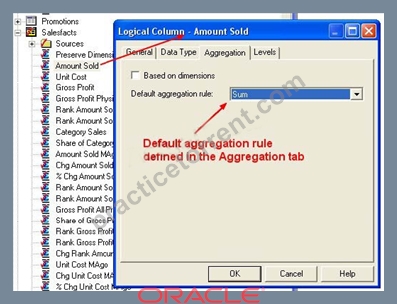
http://gerardnico.com/wiki/_media/dat/obiee/bi_server/design/obiee_measure_column.jpg
NEW QUESTION # 22
Identify the two Object level security functions that are done on the repository by using the BI Admin tool.
- A. Create a web catalog group
- B. Assign users to a web catalog group
- C. Create a new user in the repository
- D. Define permissions for Dashboard
- E. Create a new repository group
Answer: C,E
Explanation:
The Oracle Business Intelligence (BI) Administration Tool can be used to build, modify, enhance, and manage an Oracle BI repository.
C: To add a new user to a repository
1 Open a repository in the Administration Tool.
2 Display the security manager by selecting Manage > Security.
3 Select Action > New > User to open the User dialog box.
4 Type a name and password for the user.
5 If you want to log queries for this user in the query log, change the query logging level to 1 or 2.
6 Click OK.
This creates a new user with default rights granted to it.
Note: What is Oracle BI Admin Tool/Oracle Business Intelligence Administration Tool?
Oracle Business Intelligence Administration Tool is Used to manage OBIEE server Available only for Windows operating systems.
A Windows application that allows the BI Server administrator to create & edit repositories.
Can edit repositories in either online or offline mode.
Having a session manager and a cache manager in online mode.
NEW QUESTION # 23
How do you get the BI plug-in for MS Office?
- A. By downloading it from the Database Server
- B. By contacting the administrator
- C. By downloading it from Microsoft Server
- D. By downloading it from the BI Server
Answer: D
Explanation:
Explanation
Download and installation of the client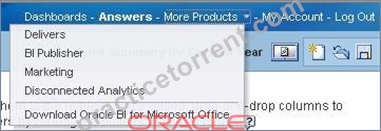
The client install executable is available for download from the More Products menu in Oracle BI Interactive Dashboards and Oracle BI Answers.
See picture below.
http://gerardnico.com/wiki/_media/dat/obiee/moreproducts.gif
NEW QUESTION # 24
The three metadata layers are an important concept of the BI Server. Which statement is incorrect?
- A. Separating the logical of the application from the physical model provides the ability to federate multiple physical sources to the same logical object.
- B. The physical layer defines the objects and relationships that the Oracle BI Server needs to write native queries against each physical data source.
- C. The presentation layer defines the relationship that is needed to create the DML.
- D. The model and mapping layer define the business or logical model of the data. This layer determines the analytic behavior seen by users.
Answer: C
Explanation:
Explanation
The relationship is defined at the model and mapping layer.
Note:
At the highest level, an OBIEE Metadata Repository includes three layers of information:
1.
First, a Physical layer is defined. The metadata layer identifies the source data.
2.Second, a Business Model and Mapping layer is defined. This metadata layer organizes the physical layer into logical categories and records the appropriate metadata for access to the source data.
3.Finally, the Presentation layer is defined. This metadata layer exposes the business model entities for end-user access.
NEW QUESTION # 25
What is an example of a Session Variable?
- A. Top Customers by Revenue
- B. User Organization
- C. ETL Load Date
- D. OLAP DSN
Answer: B
Explanation:
Note 1: There are four types of variables that you can use:
Session
Repository
Presentation
Request
Note 2: Session Variables
A session variable is a variable that is initialized at login time for each user. When a user begins a
session, the Oracle BI Server creates a new instance of a session variable and initializes it.
There are as many instances of a session variable as there are active sessions on the Oracle BI
Server. Each instance of a session variable could be initialized to a different value.
There are two types of session variables:
System - A session variable that the Oracle BI Server and Oracle BI Presentation Services use
for specific purposes.
System session variables have reserved names that cannot be used for other kinds of variables
(such as static or dynamic repository variables and non-system session variables).
Non-system - A system variable that the administrator creates and names. For example, the
administrator might create a SalesRegion non-system variable that initializes the name of a user's
sales region.
The administrator creates non-system session variables using the Oracle BI Administration Tool.
NEW QUESTION # 26
An organization has re-implemented one of its systems but has not moved history. One database has data for all years up to 2010 and the other has data for years from 2011 to the present. The organization needs data from the years 2010 and 2011 on a single report. How can you model this in the RPD?
- A. By creating two logical table sources and checking the "This Source should be combined with other sources at this level" box leaving the Fragmentation content area blank.
- B. By creating joins in the physical model so it looks like a single table
- C. By creating one logical table sources and checking the "This Source should be combined with other sources at this level" box
- D. By creating two logical table sources, that specify in Content tab using the Fragmentation content areas to specify the years for each source
- E. By creating two Logical Fact Tables for each database
Answer: D
Explanation:
Note: This source should be combined with other sources at this level (check box)
Description: Check this box when data sources at the same level of aggregation do not contain
overlapping information. In this situation, all sources must be combined to get a complete picture
of information at this level of aggregation.
Note 2: To use a source correctly, the Analytics Server has to know what each source contains in
terms of the business model. Therefore, you need to define aggregation content for each logical
table source of a fact table. The aggregation content rule defines at what level of granularity the data is stored in this fact table.
Use the Content tab of the Logical Table Source dialog box to define any aggregate table content definitions, fragmented table definitions for the source, and Where clauses (if you want to limit the number of rows returned).
Reference: Siebel Business Analytics Server Administration Guide > Creating and Administering the Business Model and Mapping Layer in a Repository > Creating and Administering Logical Table Sources (Mappings) > Defining Content of Logical Table Sources
NEW QUESTION # 27
What are the two disadvantages of implementing Query Caching?
- A. Reduction in BI server processing time
- B. Needs a lot of administrators' time
- C. Cache results being old
- D. Increased network traffic
- E. Storage space for cache
Answer: C,E
Explanation:
B: The problem with caching of any kind is how to deal with stale data. How you decide to deal with this depends on how time critical your business intelligence queries happen to be. OBIEE provides a wide variety of mechanisms for dealing with stale data. The cache can be purged automatically at intervals. Caching can be enabled selectively for individual physical tables, so that data in a frequently updated table is never cached.
OBIEE provides a set of ODBC procedures that can be called when ETL processes complete to programmatically purge designated tables. But, by far the best way to selectively purge the cache is to use an event polling table. This table is populated by the client database whenever changes are made to any table (by an ETL process for a data warehouse or by a table-based trigger for an OLTP database). At specified intervals the BI Server polls this event polling table and deletes from its cache any query results that are dependent on the changed data.
NEW QUESTION # 28
There are two aggregate tables that are available for query. How would they be mapped into the logical data model so queries can use them?
- A. By creating two new logical tables sources
- B. Both A and B
- C. By creating one new Logical Table Source
- D. By opening the two logical Table Source dialog boxes and mapping the appropriate levels in the Content tab
Answer: D
Explanation:
Explanation/Reference:
B: Example:
1. Configure the new source table to have the 'logical level' under the content set to 'Countries' (the summarized level)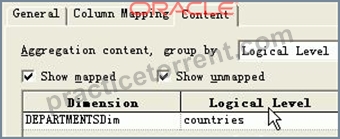
b
2. Do the similiar setting for dimension table
Now when user query the data at 'Counties' level, the query will be redirected to these summary table instead of the more detail fact table
Note: Aggregate tables are Physical tables that store Aggregates of measures across multiple levels of a Hierarchy.
NEW QUESTION # 29
Which OBIEE capability enables developers to build Aggregate tables?
- A. Table Builder
- B. Expression Builder
- C. Aggregate Persistence Wizard
- D. Query Analyzer
Answer: C
Explanation:
Explanation/Reference:
Aggregate Persistence Wizard automates the creation and initial population of aggregates, persists them in a back-end database and configures the BI Server metadata layer so that they're used when appropriate.
NEW QUESTION # 30
A customer frequently queries multiple dimension tables without a measure. What needs to be defined in the presentation layer?
- A. Logical Column Name
- B. Custom Display Name
- C. Implicit Fact Column
- D. Logical Key
- E. Alias
Answer: A
Explanation:
Explanation
You can define calculations in either of the following ways:- Before the aggregation, in the logical table source. For example:sum(col_A *( col_B))- After the aggregation, in a logical column derived from two other logicalcolumns. For example:sum(col A) * sum(col B)
NEW QUESTION # 31
The WebLogic Repository Schema generated via RCU can be deployed to which three DBMS?
- A. IBMDB2
- B. Teradata
- C. Oracle RDBMS
- D. Microsoft SQL Server
Answer: A,C,D
Explanation:
BIEE 11g Install High level Steps :
Software Required
1.Database (Oracle, IBM DB2 or MS-SQL)
2.Repository Creation Utility (RCU)
3.OBIEE 11g (11.1.1.3 is latest OBIEE as of 30 April 2011)
4.WebLogic 10.3.3 (Optional - Only required for 64 bit machine or IBM AIX)
5.JDK 1.6 64 bit (Optional - Only required for 64 bit machine)
NEW QUESTION # 32
One benefit of adding a second table source that is joined to the first table source in the Physical Layer by a foreign key relationship is that______.
- A. Two SQL queries are performed to get data from both tables
- B. Multiple SQL queries are performed
- C. No SQL queries are performed against the source tables
- D. A single SQL query is performed to get data from both tables
Answer: D
Explanation:
Explanation
A single query can be performed accessing data from both tables through a join on the columns in the foreign key relation.
NEW QUESTION # 33
The Oracle BI office plug-in allows you to import the results of an OBI request into which two MS applications?
- A. MS Excel
- B. MS Visio
- C. MS Word
- D. MS Project
Answer: A,C
Explanation:
Explanation/Reference:
Oracle Business Intelligence Office Plug-In is a Windows application that is an optional feature under the Oracle Business Intelligence Presentation Services. The Plug-In provides a way to browse the Analytics catalog, select a report, and then drop that report into Microsoft Word or Excel.
Reference: Oracle Business Intelligence Infrastructure Installation and Configuration Guide > Installing Individual Oracle BI Components >Installing Oracle BI Office Plug-In
NEW QUESTION # 34
Which analysis features could be applied to provide interactive controls for end users?
- A. Action Links
- B. Conditional Formatting
- C. Narrative View
- D. Column Selector
- E. Greenbar Styling
Answer: A
Explanation:
Explanation/Reference:
An action link is a link to an action that you have embedded in an analysis, dashboard page, scorecard objective, scorecard initiative, or KPI that, when clicked, runs an associated action.
Incorrect answers:
D: Use the Narrative view to add one or more paragraphs of text to appear with the results. Narrative text is useful for providing information such as context, explanatory text, or extended descriptions.
E: OBIEE "Greenbar" Customization
Green bar reporting is alternating the row background colour every odd and even row
NEW QUESTION # 35
An organization would like to see a Time folder with subfolders for its Fiscal and Julian calendars. How would you accomplish this?
- A. By creating Presentation Folder called Time and then two subsequent folders called -> Fiscal Calendar and -> Julian Calendar
- B. By creating a Presentation Folder called Time<parent> and then two subsequent folders called Fiscal Calendar<child> and Julian Calendar<child>
- C. By creating a Presentation Folder called -Time and then two subsequent folders called + Fiscal Calendar and + Julian Calendar
- D. By creating a Presentation Folder called ->Time called then two subsequent folders called Fiscal Calendar and Julian Calendar
Answer: A
Explanation:
You can nest presentation folders in two ways.
1) You can enter a hyphen and a greater than sign in the description field of the table to achieve the result.
2) Or, prefix the name of the presentation folder to be nested with a hyphen and a space and place it after the folder in which it nests to achieve the same result as shown below.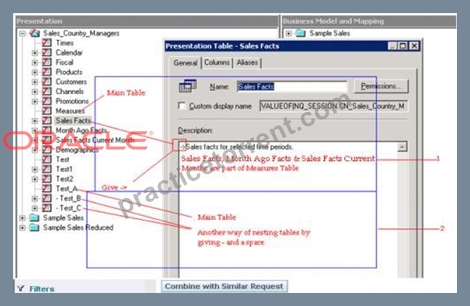
Result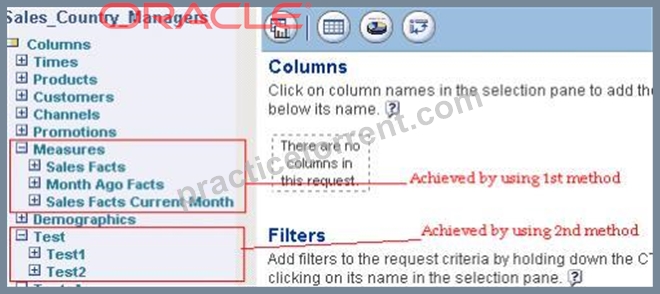
NEW QUESTION # 36
Oracle BI Server at a company is connected to Data Warehouse that is refreshed on a daily basis, the majority of users at the company log in to Oracle BI every Monday to generate the previous week's sales report. The BI Administrator schedules cache purge and cache seeding to improve
report response times. How is this accomplished?
- A. Every day after Data Warehouse refresh
- B. Every Monday late night
- C. Everyday before Data Warehouse refresh
- D. Every Monday early morning
Answer: B
Explanation:
Purge and reseed once a week after the reports have run to improve report response time.
NEW QUESTION # 37
Query Limits are used to manage Query environment in the repository for users and roles and can_________.
- A. Control User Authentication
- B. Limit Queries by maximum run time
- C. Control Write Back Capabilities
- D. Control runaway queries
- E. Control aggregation
Answer: B
Explanation:
Explanation/Reference:
Query Limits. You can limit queries by the number of rows received, by maximum run time, and by restricting to particular time periods. You can also allow or disallow direct database requests or the Populate privilege.
See figure below.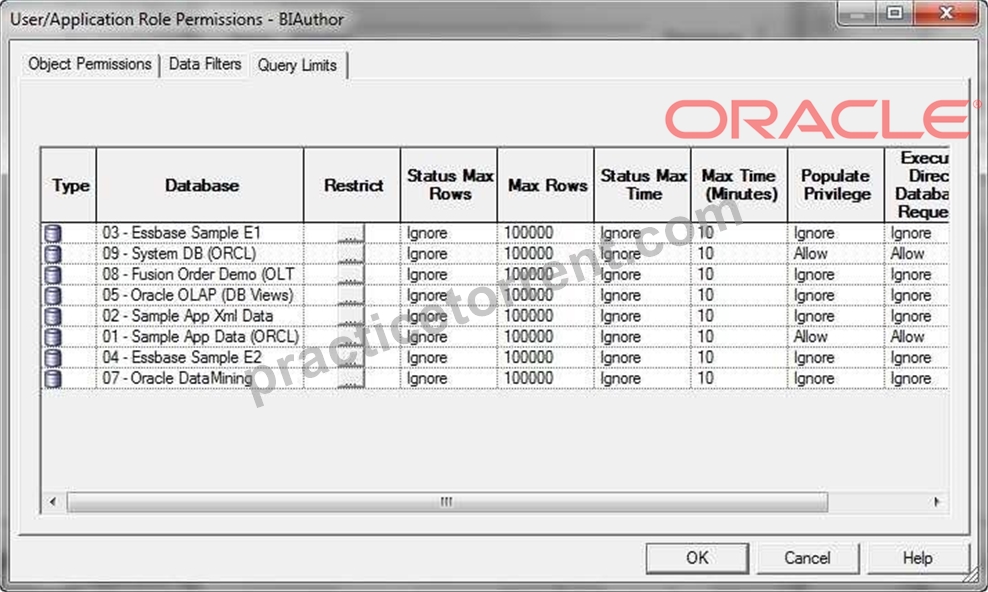
NEW QUESTION # 38
Which option is not an example of a level-based measure?
- A. Employee Salary
- B. Sales
- C. Regional Revenue
- D. Brand Cost
Answer: D
Explanation:
Explanation
Note 1: A level-based measure is a column whose values are always calculated to a specific level of aggregation.
The calculation of this measure is independent of the query grain and used always the aggregation grain of the logical column.
Level-based measures allow :
* to return data at multiple levels of aggregation (the query grain and the level-based column grain) with one single query
* to create share measures (percentage), that are calculated by taking some measure and dividing it by a level-based measure. For example, you can divide salesperson revenue by regional revenue to calculate the share of the regional revenue each salesperson generates.
Note 2: To create a level based measure as the amount sold by region, you can:
* make a copy of the Amount Sold logical column
* and then
/ drag the logical column into its hierarchy level
/ or set the aggregation grain in the level tab of the logical column property.
NEW QUESTION # 39
Which of the following characteristics pertain to a "ragged" hierarchy?
- A. It creates multiple levels of hierarchy in the database table.
- B. All values can have a maximum of six levels.
- C. A branch of the hierarchy may have a different number of levels than other branches.
- D. It can only be stored in an XML structure.
Answer: C
Explanation:
Ragged Hierarchies are hierarchies where some routes down the hierarchy are longer than others; for example, you may have an organizational hierarchy for salespeople where the overall boss has two assistant managers, one of them works on their own and another has three sales managers under them; some of those sales manager may have sales staff under them, and some sales staff may have trainees under them.
NEW QUESTION # 40
There are two aggregate tables that are available for query. How would they be mapped into the logical data model so queries can use them?
- A. By creating two new logical tables sources
- B. Both A and B
- C. By creating one new Logical Table Source
- D. By opening the two logical Table Source dialog boxes and mapping the appropriate levels in the Content tab
Answer: D
Explanation:
B: Example:
1. Configure the new source table to have the 'logical level' under the content set to 'Countries' (the summarized level)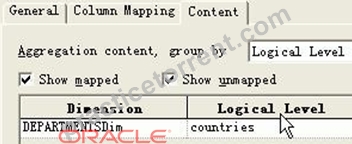
b
2. Do the similiar setting for dimension table
Now when user query the data at 'Counties' level, the query will be redirected to these summary table instead of the more detail fact table Note: Aggregate tables are Physical tables that store Aggregates of measures across multiple levels of a Hierarchy.
NEW QUESTION # 41
WLS Embedded LDAP Server is managed by the Admin Server Console and supports which three options?
- A. Subject area and row-level security, connection pool passwords
- B. Authentication and Authorization
- C. Basic Directory for storing user details
- D. Application of Session Variables as Data Filters
- E. Creating and Maintaining Users
Answer: A,C,E
Explanation:
Explanation/Reference:
WLS Embedded LDAP Server
*By default, OBIEE 11g users and groups are now held in the WLS LDAP Server (C)
- More robust directory for storing user details
- Recommended for >1000 users
* WLS Admin Server Console now used for
creating and maintaining users (A)
* BI Server "outsources" all authentication,
authorization to FMW11g (not B)
* BI Administration tool now used for
subject area and row-level security,
connection pool passwords only (D)
* WLS LDAP Server can be "swapped out"
for alternative directories (MS AD etc)
NEW QUESTION # 42
Which three options apply to FMW Application Roles?
- A. Provide an indirection between LDAP groups and BI roles
- B. Can be created by using BI Administrator Client and "pushed" to WLS Admin Console
- C. Can be exported / moved between FMW11g environments
- D. Are created and managed by using the WLS Admin Console and FMW Control
- E. Secures RPD permissions but NOT Web Catalog (webcat) permissions
Answer: A,D,E
Explanation:
A: The default Application Roles available after OBIEE 11g installation are BIAdministrator, BISystem, BIConsumer and BIAuthor.
Note: In OBIEE 11g, Application roles provide insulation between permission definitions and corporate LDAP Groups. Permissions are defined at Application Role level and changes to LDAP groups just require a reassignment of the Group to the Application Roles.
See figure below: security_12.jpg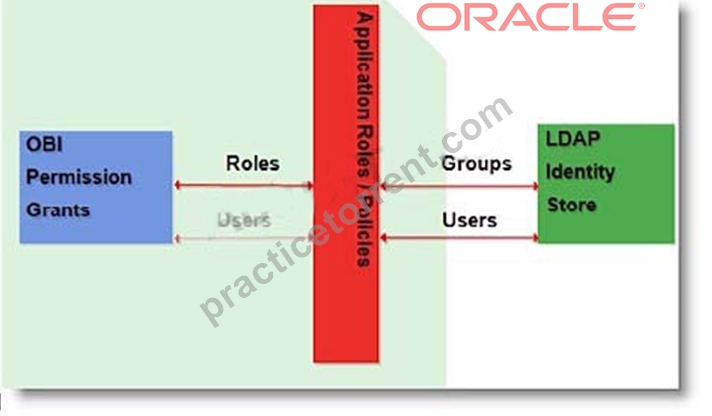
C: Application Roles, Policies, association of Policies to application roles and association of users and groups to application roles are managed using Fusion Middleware Enterprise Manager (FMW EM).
E: Object level permission association to Applications Roles resides in the RPD for repository objects. Permissions and Privilege for web catalog objects resides in the OBIEE Web Catalog. Wherever Groups were used in the web catalog and RPD has been replaced with Application roles in OBIEE 11g.
Note: Application Roles are introduced in OBIEE 11g. An application role is specific to the application. They can be mapped to other application roles defined in the same application scope and also to enterprise users or groups, and they are used in authorization decisions.
NEW QUESTION # 43
A derived measure is never used to_________.
- A. Input data
- B. Add two logical columns together
- C. Calculate share measures
- D. Calculate a variance between two measures
- E. Calculate the rank dimension values
Answer: A
NEW QUESTION # 44
When creating a Security Realm in the WebLogic Console, which object is created?
- A. Single Sign On
- B. Server Password
- C. Groups
- D. Row Level Filters
Answer: C
Explanation:
Explanation
Security Realms are an Oracle Platform Security Services concept and bring together sets of users, groups, providers and so on for a WebLogic domain.
NEW QUESTION # 45
......
1z0-591 Sample Practice Exam Questions 2026 Updated Verified: https://actual4test.practicetorrent.com/1z0-591-practice-exam-torrent.html