


[Full-Version] 2025 Updated CompTIA Study Guide PT0-003 Dumps Questions
Newest PT0-003 Exam Dumps Achieve Success in Actual PT0-003 Exam
CompTIA PT0-003 Exam Syllabus Topics:
| Topic | Details |
|---|---|
| Topic 1 |
|
| Topic 2 |
|
| Topic 3 |
|
| Topic 4 |
|
| Topic 5 |
|
NEW QUESTION # 51
During a penetration test, the tester identifies several unused services that are listening on all targeted internal laptops. Which of the following technical controls should the tester recommend to reduce the risk of compromise?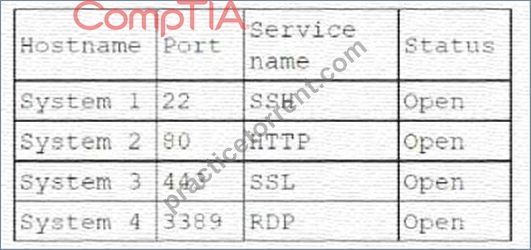
- A. System hardening
- B. Patch management
- C. Multifactor authentication
- D. Network segmentation
Answer: A
Explanation:
When a penetration tester identifies several unused services listening on targeted internal laptops, the most appropriate recommendation to reduce the risk of compromise is system hardening. Here's why:
* System Hardening:
* Purpose: System hardening involves securing systems by reducing their surface of vulnerability.
This includes disabling unnecessary services, applying security patches, and configuring systems securely.
* Impact: By disabling unused services, the attack surface is minimized, reducing the risk of these services being exploited by attackers.
* Comparison with Other Controls:
* Multifactor Authentication (A): While useful for securing authentication, it does not address the issue of unused services running on the system.
* Patch Management (B): Important for addressing known vulnerabilities but not specifically related to disabling unused services.
* Network Segmentation (D): Helps in containing breaches but does not directly address the issue of unnecessary services.
System hardening is the most direct control for reducing the risk posed by unused services, making it the best recommendation.
NEW QUESTION # 52
A penetration tester completed OSINT work and needs to identify all subdomains for mydomain.com. Which of the following is the best command for the tester to use?
- A. cat wordlist.txt | xargs -n 1 -I 'X' dig X.mydomain.com
- B. dig @8.8.8.8 mydomain.com ANY /path/to/results.txt
- C. crunch 1 2 | xargs -n 1 -I 'X' nslookup X.mydomain.com
- D. nslookup mydomain.com /path/to/results.txt
Answer: A
Explanation:
Using dig with a wordlist to identify subdomains is an effective method for subdomain enumeration. The command cat wordlist.txt | xargs -n 1 -I 'X' dig X.mydomain.com reads each line from wordlist.txt and performs a DNS lookup for each potential subdomain.
Step-by-Step Explanation
Command Breakdown:
cat wordlist.txt: Reads the contents of wordlist.txt, which contains a list of potential subdomains.
xargs -n 1 -I 'X': Takes each line from wordlist.txt and passes it to dig one at a time.
dig X.mydomain.com: Performs a DNS lookup for each subdomain.
Why This is the Best Choice:
Efficiency: xargs efficiently processes each line from the wordlist and passes it to dig for DNS resolution.
Automation: Automates the enumeration of subdomains, making it a practical choice for large lists.
Benefits:
Automates the process of subdomain enumeration using a wordlist.
Efficiently handles a large number of subdomains.
Reference from Pentesting Literature:
Subdomain enumeration is a critical part of the reconnaissance phase in penetration testing. Tools like dig and techniques involving wordlists are commonly discussed in penetration testing guides.
HTB write-ups often detail the use of similar commands for efficient subdomain enumeration.
Reference:
Penetration Testing - A Hands-on Introduction to Hacking
HTB Official Writeups
NEW QUESTION # 53
During a test of a custom-built web application, a penetration tester identifies several vulnerabilities. Which of the following would be the most interested in the steps to reproduce these vulnerabilities?
- A. Operations staff
- B. Developers
- C. C-suite executives
- D. Third-party stakeholders
Answer: B
Explanation:
The developers would be the most interested in the steps to reproduce the web application vulnerabilities, because they are responsible for fixing the code and implementing security best practices. The steps to reproduce the vulnerabilities would help them understand the root cause of the problem, test the patches, and prevent similar issues in the future. The other options are less interested in the technical details of the vulnerabilities, as they have different roles and responsibilities. The operations staff are more concerned with the availability and performance of the web application, the third-party stakeholders are more interested in the business impact and risk assessment of the vulnerabilities, and the C-suite executives are more focused on the strategic and financial implications of the vulnerabilities123. References:
*The Official CompTIA PenTest+ Study Guide (Exam PT0-002) eBook, Chapter 1, Lesson 1.4, Topic 1.4.1:
Explain the importance of communication during the penetration testing process
*Web Application Penetration Testing: Steps, Methods, and Tools, SecureTriad article
*Web Application Security Testing: A Step-by-Step Guide, Acunetix article
NEW QUESTION # 54
During an assessment, a penetration tester manages to get RDP access via a low-privilege user. The tester attempts to escalate privileges by running the following commands:
Import-Module .\PrintNightmare.ps1
Invoke-Nightmare -NewUser "hacker" -NewPassword "Password123!" -DriverName "Print" The tester attempts to further enumerate the host with the new administrative privileges by using the runas command. However, the access level is still low. Which of the following actions should the penetration tester take next?
- A. Log off and log on with "hacker".
- B. Attempt to add another user.
- C. Add a malicious printer driver.
- D. Bypass the execution policy.
Answer: A
Explanation:
In the scenario where a penetration tester uses the PrintNightmare exploit to create a new user with administrative privileges but still experiences low-privilege access, the tester should log off and log on with the new "hacker" account to escalate privileges correctly.
PrintNightmare Exploit:
PrintNightmare (CVE-2021-34527) is a vulnerability in the Windows Print Spooler service that allows remote code execution and local privilege escalation.
The provided commands are intended to exploit this vulnerability to create a new user with administrative privileges.
Commands Breakdown:
Import-Module .\PrintNightmare.ps1: Loads the PrintNightmare exploit script.
Invoke-Nightmare -NewUser "hacker" -NewPassword "Password123!" -DriverName "Print": Executes the exploit, creating a new user "hacker" with administrative privileges.
Issue:
The tester still experiences low privileges despite running the exploit successfully.
This could be due to the current session not reflecting the new privileges.
Solution:
Logging off and logging back on with the new "hacker" account will start a new session with the updated administrative privileges.
This ensures that the new privileges are applied correctly.
Pentest Reference:
Privilege Escalation: After gaining initial access, escalating privileges is crucial to gain full control over the target system.
Session Management: Understanding how user sessions work and ensuring that new privileges are recognized by starting a new session.
The use of the PrintNightmare exploit highlights a specific technique for privilege escalation within Windows environments.
By logging off and logging on with the new "hacker" account, the penetration tester can ensure the new administrative privileges are fully applied, allowing for further enumeration and exploitation of the target system.
NEW QUESTION # 55
A penetration tester runs a vulnerability scan that identifies several issues across numerous customer hosts.
The executive report outlines the following: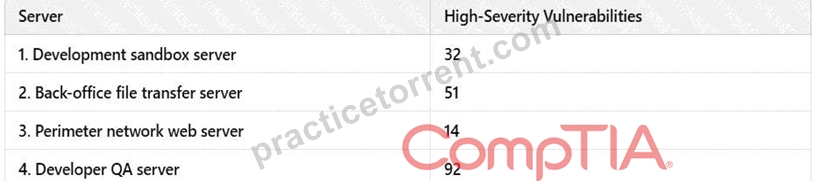
The client is concerned about the availability of its consumer-facing production application. Which of the following hosts should the penetration tester select for additional manual testing?
- A. Server 2
- B. Server 4
- C. Server 1
- D. Server 3
Answer: D
Explanation:
Since the client is worried about the availability of their consumer-facing application, the perimeter network web server (Server 3) is the most critical because:
It is internet-facing, making it a prime target for attackers.
A compromise could lead to data breaches, downtime, or service disruptions.
Even though it has fewer vulnerabilities (14 vs. 92 on QA server), its exposure is higher.
Option A (Development sandbox server) #: Internal and not publicly accessible.
Option B (Back-office file transfer server) #: Important, but not consumer-facing.
Option C (Perimeter web server) #: Correct. Publicly accessible and critical to operations.
Option D (Developer QA server) #: May have more vulnerabilities, but it's less critical.
# Reference: CompTIA PenTest+ PT0-003 Official Guide - Prioritizing Vulnerability Testing
NEW QUESTION # 56
A penetration tester presents the following findings to stakeholders:
Control | Number of findings | Risk | Notes
Encryption | 1 | Low | Weak algorithm noted
Patching | 8 | Medium | Unsupported systems
System hardening | 2 | Low | Baseline drift observed
Secure SDLC | 10 | High | Libraries have vulnerabilities
Password policy | 0 | Low | No exceptions noted
Based on the findings, which of the following recommendations should the tester make? (Select two).
- A. Write an SDLC policy.
- B. Implement an SCA tool.
- C. Obtain the latest library version.
- D. Develop a secure encryption algorithm.
- E. Deploy an asset management system.
- F. Patch the libraries.
Answer: B,C
Explanation:
Based on the findings, the focus should be on addressing vulnerabilities in libraries and ensuring their security. Here's why options D and E are correct:
* Implement an SCA Tool:
* SCA (Software Composition Analysis) tools are designed to analyze and manage open-source components in an application. Implementing an SCA tool would help in identifying and managing vulnerabilities in libraries, aligning with the finding of vulnerable libraries in the secure SDLC process.
* This recommendation addresses the high-risk finding related to the Secure SDLC by providing a systematic approach to manage and mitigate vulnerabilities in software dependencies.
* Obtain the Latest Library Version:
* Keeping libraries up to date is a fundamental practice in maintaining the security of an application. Ensuring that the latest, most secure versions of libraries are used directly addresses the high-risk finding related to vulnerable libraries.
* This recommendation is a direct and immediate action to mitigate the identified vulnerabilities.
Other Options Analysis:
* Develop a Secure Encryption Algorithm: This is not practical or necessary given that the issue is with the use of a weak algorithm, not the need to develop a new one.
* Deploy an Asset Management System: While useful, this is not directly related to the identified high- risk issue of vulnerable libraries.
* Write an SDLC Policy: While helpful, the more immediate and effective actions involve implementing tools and processes to manage and update libraries.
References from Pentest:
* Horizontall HTB: Demonstrates the importance of managing software dependencies and using tools to identify and mitigate vulnerabilities in libraries.
* Writeup HTB: Highlights the need for keeping libraries updated to ensure application security and mitigate risks.
Conclusion:
Options D and E, implementing an SCA tool and obtaining the latest library version, are the most appropriate recommendations to address the high-risk finding related to vulnerable libraries in the Secure SDLC process.
NEW QUESTION # 57
During a testing engagement, a penetration tester compromises a host and locates data for exfiltration. Which of the following are the best options to move the data without triggering a data loss prevention tool? (Select two).
- A. Move the data using a USB flash drive.
- B. Use FTP for exfiltration.
- C. Send the data to a commonly trusted service.
- D. Encode the data as Base64.
- E. Compress and encrypt the data.
- F. Rename the file name extensions.
Answer: D,E
Explanation:
Data Loss Prevention (DLP) tools monitor sensitive data and prevent unauthorized exfiltration. The two best options to bypass DLP are:
* Compress and encrypt the data (Option B):
* Compression reduces file size, making detection harder. Encryption further protects the data by making it unreadable without a key.
* DLP tools often inspect content based on known patterns (e.g., credit card numbers, sensitive keywords). Encrypted files bypass content inspection since DLP cannot analyze encrypted data.
NEW QUESTION # 58
A company that requires minimal disruption to its daily activities needs a penetration tester to perform information gathering around the company's web presence. Which of the following would the tester find MOST helpful in the initial information-gathering steps? (Choose two.)
- A. Internet search engines
- B. Externally facing open ports
- C. Zone transfers
- D. DNS forward and reverse lookups
- E. Shodan results
- F. IP addresses and subdomains
Answer: A,F
Explanation:
A: IP addresses and subdomains. This is correct. IP addresses and subdomains are useful information for a penetration tester to identify the scope and range of the company's web presence. IP addresses can reveal the location, network, and service provider of the company's web servers, while subdomains can indicate the different functions and features of the company's website. A penetration tester can use tools like whois, Netcraft, or DNS lookups to find IP addresses and subdomains associated with the company's domain name.
D: Internet search engines. This is correct. Internet search engines are powerful tools for a penetration tester to perform passive information gathering around the company's web presence. Search engines can provide a wealth of information, such as the company's profile, history, news, social media accounts, reviews, products, services, customers, partners, competitors, and more. A penetration tester can use advanced search operators and keywords to narrow down the results and find relevant information. For example, using the site: operator can limit the results to a specific domain or subdomain, while using the intitle: operator can filter the results by the title of the web pages.
NEW QUESTION # 59
During a penetration test, the tester gains full access to the application's source code. The application repository includes thousands of code files. Given that the assessment timeline is very short, which of the following approaches would allow the tester to identify hard-coded credentials most effectively?
- A. Use SCA software to scan the application source code
- B. Run TruffleHog against a local clone of the application
- C. Perform a manual code review of the Git repository
- D. Scan the live web application using Nikto
Answer: B
Explanation:
Given a short assessment timeline and the need to identify hard-coded credentials in a large codebase, using an automated tool designed for this specific purpose is the most effective approach. Here's an explanation of each option:
* Run TruffleHog against a local clone of the application (answer: A):
* Explanation: TruffleHog is a specialized tool that scans for hard-coded secrets such as passwords, API keys, and other sensitive data within the code repositories.
* Effectiveness: It quickly and automatically identifies potential credentials and other sensitive information across thousands of files, making it the most efficient choice under time constraints.
* References:
* TruffleHog is widely recognized for its ability to uncover hidden secrets in code repositories, making it a valuable tool for penetration testers.
* Scan the live web application using Nikto (Option B):
* Explanation: Nikto is a web server scanner that identifies vulnerabilities in web applications.
* Drawbacks: It is not designed to scan source code for hard-coded credentials. Instead, it focuses on web application vulnerabilities such as outdated software and misconfigurations.
* Perform a manual code review of the Git repository (Option C):
* Explanation: Manually reviewing code can be thorough but is extremely time-consuming, especially with thousands of files.
* Drawbacks: Given the short timeline, this approach is impractical and inefficient for identifying hard-coded credentials quickly.
* Use SCA software to scan the application source code (Option D):
* Explanation: Software Composition Analysis (SCA) tools are used to analyze open source and third-party components within the code for vulnerabilities and license compliance.
* Drawbacks: While SCA tools are useful for dependency analysis, they are not specifically tailored for finding hard-coded credentials.
Conclusion: Running TruffleHog against a local clone of the application is the most effective approach for quickly identifying hard-coded credentials in a large codebase within a limited timeframe.
NEW QUESTION # 60
A company's Chief Executive Officer has created a secondary home office and is concerned that the WiFi service being used is vulnerable to an attack. A penetration tester is hired to test the security of the WiFi's router.
Which of the following is MOST vulnerable to a brute-force attack?
- A. WPA2-PSK
- B. WPA-TKIP
- C. WPS
- D. WPA2-EAP
Answer: C
Explanation:
Reference: https://us-cert.cisa.gov/ncas/alerts/TA12-006A
NEW QUESTION # 61
Which of the following lock-picking techniques is faster but less precise, used when speed is prioritized over precision?
- A. Bypassing
- B. Raking
- C. Plug spinner
- D. Decoding
Answer: B
Explanation:
Lock picking techniques are used in physical security assessments to test access control mechanisms.
* Raking (Option D):
* Raking is a lock-picking technique where a rake pick is inserted and rapidly moved in and out to manipulate multiple pins simultaneously.
* It is faster but less precise than single-pin picking.
* Used when speed is prioritized over precision.
NEW QUESTION # 62
Which of the following is a term used to describe a situation in which a penetration tester bypasses physical access controls and gains access to a facility by entering at the same time as an employee?
- A. Badge cloning
- B. Tailgating
- C. Shoulder surfing
- D. Site survey
Answer: B
Explanation:
Understanding Tailgating:
Definition: Tailgating occurs when an unauthorized individual follows an authorized individual into a secure area without the need for the latter to provide credentials.
Risk: Bypasses physical access controls and can lead to unauthorized access to sensitive areas.
Methods to Prevent Tailgating:
Security Awareness: Train employees to be aware of tailgating risks and to challenge unknown individuals.
Physical Controls: Install turnstiles, mantraps, or security doors that only allow one person to enter at a time.
Monitoring: Use CCTV cameras to monitor entrances and exits.
Examples in Penetration Testing:
During a physical security assessment, a penetration tester might follow an employee into a secure area to test the effectiveness of physical security measures.
Tailgating is a common social engineering tactic used to gain unauthorized physical access.
Reference from Pentesting Literature:
Tailgating is discussed in penetration testing methodologies as a critical aspect of physical security assessments.
HTB write-ups occasionally cover scenarios where physical access was gained through tailgating.
Reference:
Penetration Testing - A Hands-on Introduction to Hacking
HTB Official Writeups
NEW QUESTION # 63
A penetration tester observes an application enforcing strict access controls. Which of the following would allow the tester to bypass these controls and successfully access the organization's sensitive files?
- A. SQL injection
- B. Cross-site scripting
- C. Insecure direct object references
- D. Remote file inclusion
Answer: C
Explanation:
Insecure Direct Object References (IDOR) vulnerabilities occur when an application provides direct access to objects based on user-supplied input. This can allow an attacker to bypass authorization and access resources in the system directly, for example database records or files1. In this case, the penetration tester could potentially bypass the strict access controls and access the organization's sensitive files. References: IDOR Vulnerability Overview
NEW QUESTION # 64
A penetration tester finishes an initial discovery scan for hosts on a /24 customer subnet. The customer states that the production network is composed of Windows servers but no container clusters. The following are the last several lines from the scan log:
Line 1: 112 hosts found... trying ports
Line 2: FOUND 22 with OpenSSH 1.2p2 open on 99 hosts
Line 3: FOUND 161 with UNKNOWN banner open on 110 hosts
Line 4: TCP RST received on ports 21, 3389, 80
Line 5: Scan complete.
Which of the following is the most likely reason for the results?
- A. IPS is blocking the ports
- B. The wrong subnet was scanned
- C. Windows is using WSL
- D. Multiple honeypots were encountered
Answer: D
Explanation:
Seeing services like OpenSSH 1.2p2 open on 99 hosts, and port 161 (SNMP) with unknown banners on 110 hosts suggests a high level of uniformity, which is uncommon in real-world Windows environments. This strongly points to honeypots being present, possibly for detection or deception.
The official CompTIA guide discusses this under scan anomalies:
"Identical responses from a large number of hosts, especially deprecated versions or unchanging banners, could indicate the presence of honeypots or decoy systems." Reference: CompTIA PenTest+ PT0-003 Official Study Guide, Chapter 5
NEW QUESTION # 65
An assessor wants to use Nmap to help map out a stateful firewall rule set. Which of the following scans will the assessor MOST likely run?
- A. nmap 192.168.0.1/24
- B. nmap -sS 192.168.0.1/24
- C. nmap -oG 192.168.0.1/24
- D. nmap -sA 192.168.0.1/24
Answer: D
Explanation:
https://nmap.org/book/scan-methods-ack-scan.html
NEW QUESTION # 66
You are a penetration tester running port scans on a server.
INSTRUCTIONS
Part 1: Given the output, construct the command that was used to generate this output from the available options.
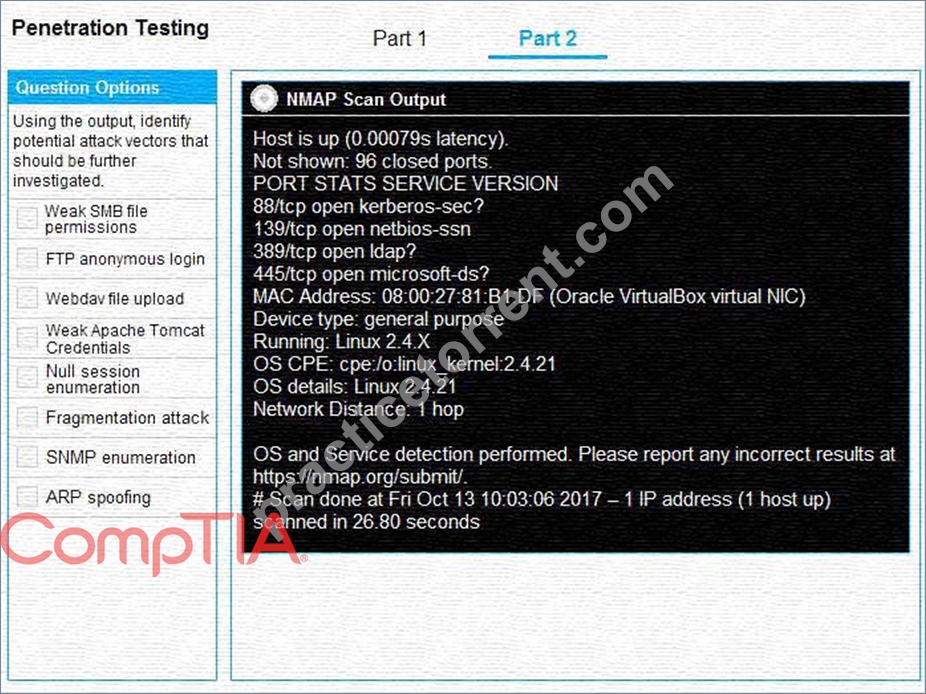
Part 2: Once the command is appropriately constructed, use the given output to identify the potential attack vectors that should be investigated further.
If at any time you would like to bring back the initial state of the simulation, please click the Reset All button.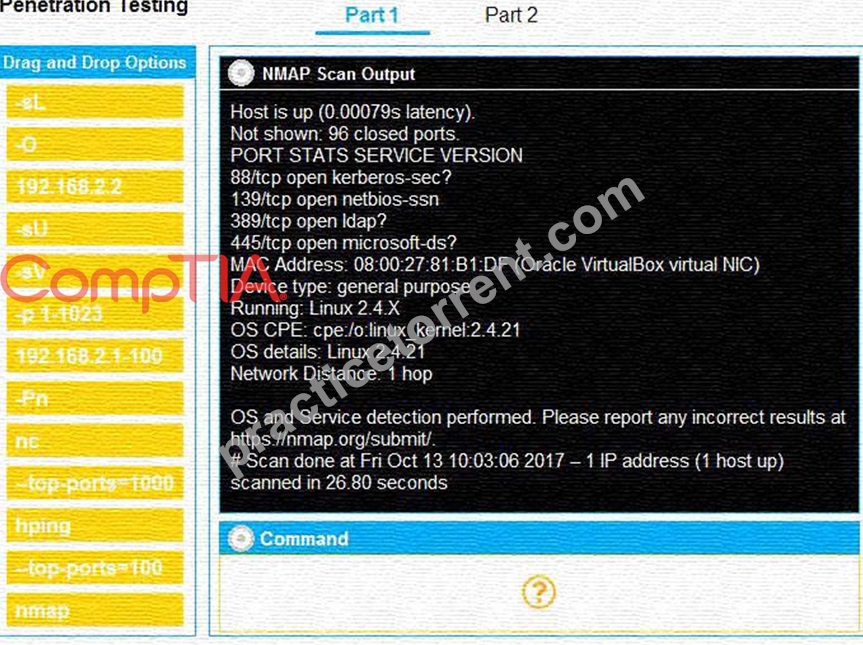
Answer:
Explanation:
See explanation below.
Explanation:
Part 1 - 192.168.2.2 -O -sV --top-ports=100 and SMB vulns
Part 2 - Weak SMB file permissions
https://subscription.packtpub.com/book/networking-and-servers/9781786467454/1/ch01lvl1sec13/fingerprinting-os-and-services-running-on-a-target-host
NEW QUESTION # 67
......
Updated CompTIA PT0-003 Dumps – Check Free PT0-003 Exam Dumps: https://actual4test.practicetorrent.com/PT0-003-practice-exam-torrent.html