


Get Ready to Pass the DY0-001 exam Right Now Using Our CompTIA Data+ Exam Package
Enhance Your Career With Available Preparation Guide for DY0-001 Exam
NEW QUESTION # 29
Which of the following is best solved with graph theory?
- A. Traveling salesman
- B. Fraud detection
- C. One-armed bandit
- D. Optical character recognition
Answer: A
Explanation:
The traveling-salesman problem is a prototypical graph theory challenge, finding the shortest tour through a graph's nodes, whereas the other tasks rely on different domains (OCR on image processing, fraud detection often on statistical/anomaly methods, bandit problems on sequential decision theory).
NEW QUESTION # 30
A data scientist observes findings that indicate that as electrical grids in a country become more and more connected over time, the frequency of brownouts and blackouts in total decrease, and the frequency of major brownouts and blackouts increase. Which of the following distribution metrics could best be identified?
- A. Kurtosis
- B. Normality
- C. Skewness
- D. Scale axis magnitudes
Answer: A
Explanation:
Kurtosis quantifies how heavy or light the tails of a distribution are. In this case, fewer overall events but more extreme (major) brownouts/blackouts indicates heavier tails over time. This is exactly what an increasing kurtosis would reveal.
NEW QUESTION # 31
A data scientist trained a model for departments to share. The departments must access the model using HTTP requests. Which of the following approaches is appropriate?
- A. Use the File Transfer Protocol.
- B. Utilize distributed computing.
- C. Deploy containers.
- D. Create an endpoint.
Answer: D
Explanation:
# Creating an endpoint allows other systems or departments to access the trained model via HTTP requests.
This typically involves exposing the model as a RESTful API, allowing it to be queried by web-based systems.
Why the other options are incorrect:
* A: Distributed computing refers to computation, not access over HTTP.
* B: Containers are useful for deployment, but the endpoint enables access.
* D: FTP is used for file transfer, not model inference via HTTP.
Official References:
* CompTIA DataX (DY0-001) Official Study Guide - Section 5.4:"Endpoints are used to expose models to external consumers over HTTP protocols, often using REST APIs."
* ML Deployment Best Practices, Chapter 3:"RESTful endpoints provide real-time access to model predictions and are key for multi-team collaboration."
NEW QUESTION # 32
The most likely concern with a one-feature, machine-learning model is high error due to:
- A. dimensionality.
- B. bias
- C. probability.
- D. variance.
Answer: B
Explanation:
A model with only one feature is unlikely to capture the true complexity of the data's underlying relationships, leading to systematic underfitting - i.e., high bias.
NEW QUESTION # 33
SIMULATION
A data scientist needs to determine whether product sales are impacted by other contributing factors. The client has provided the data scientist with sales and other variables in the data set.
The data scientist decides to test potential models that include other information.
INSTRUCTIONS
Part 1
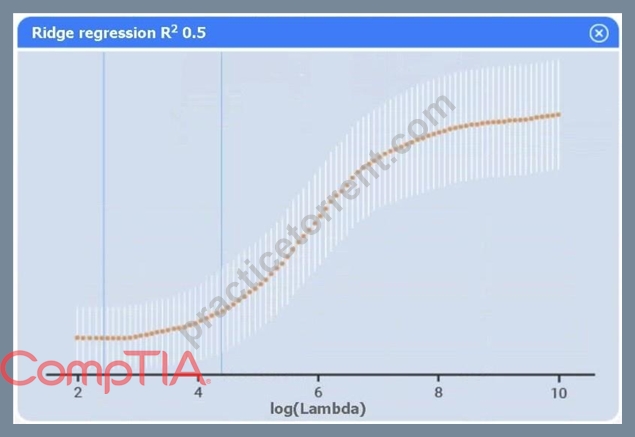
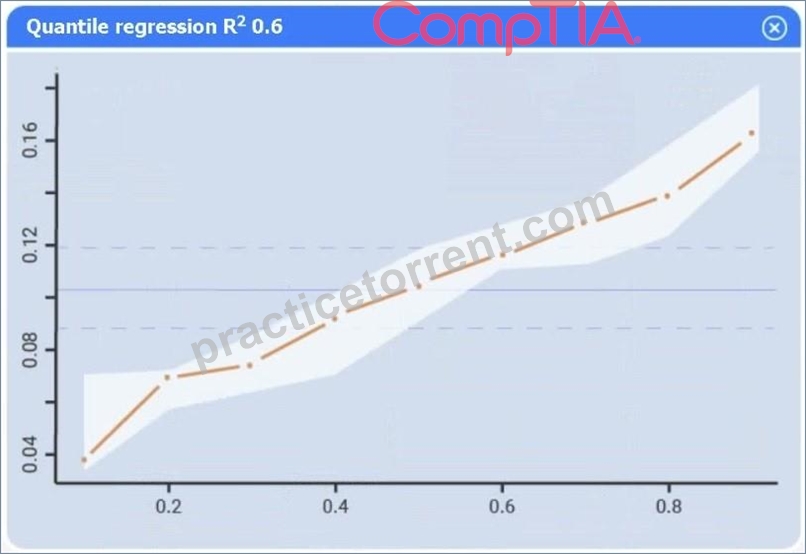
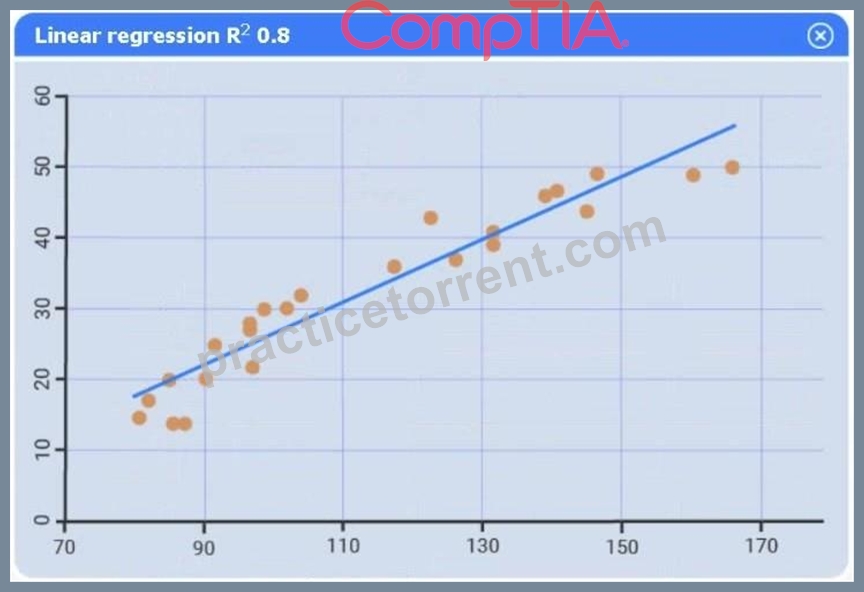
Use the information provided in the table to select the appropriate regression model.
Part 2
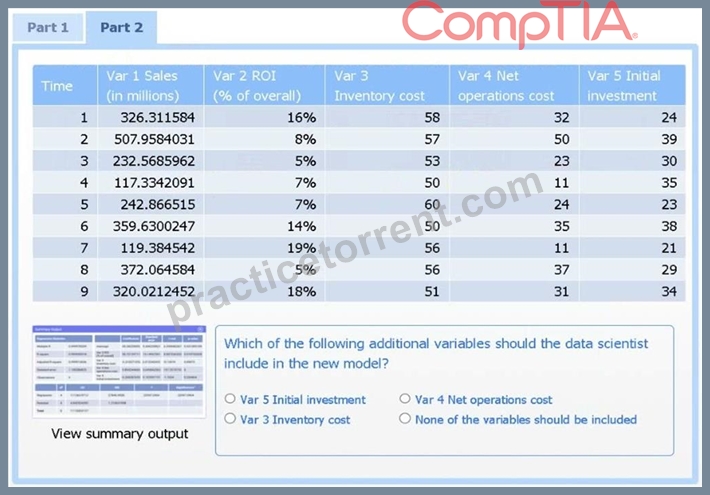
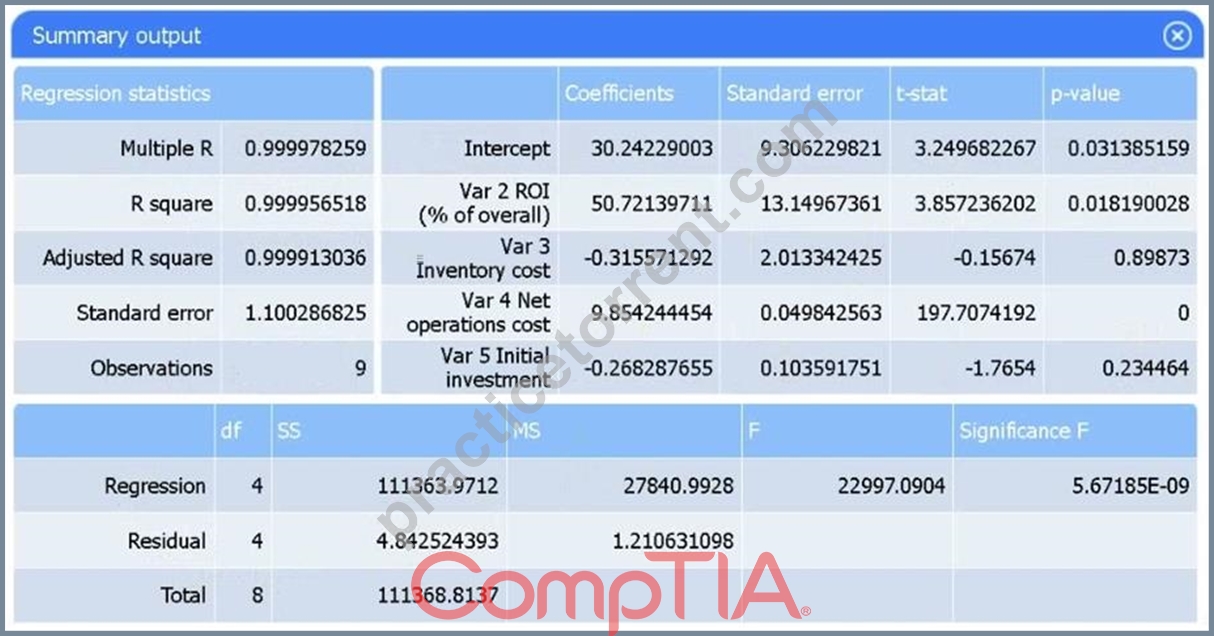
Review the summary output and variable table to determine which variable is statistically significant.
If at any time you would like to bring back the initial state of the simulation, please click the Reset All button.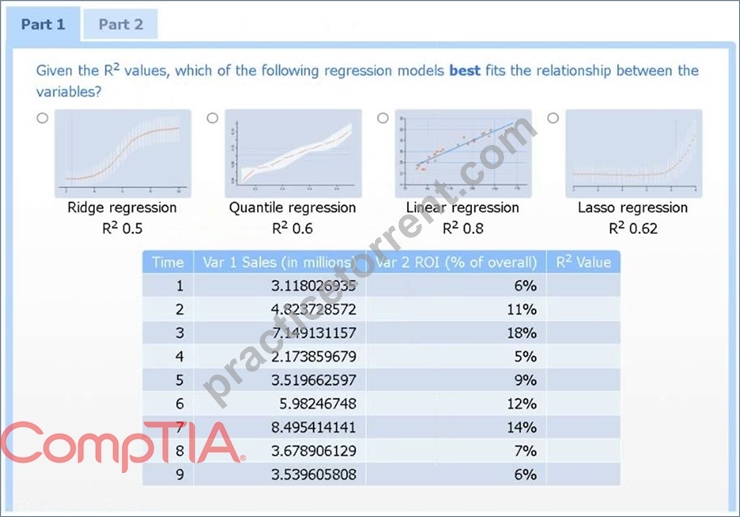
Answer:
Explanation:
Part 1
Linear regression.
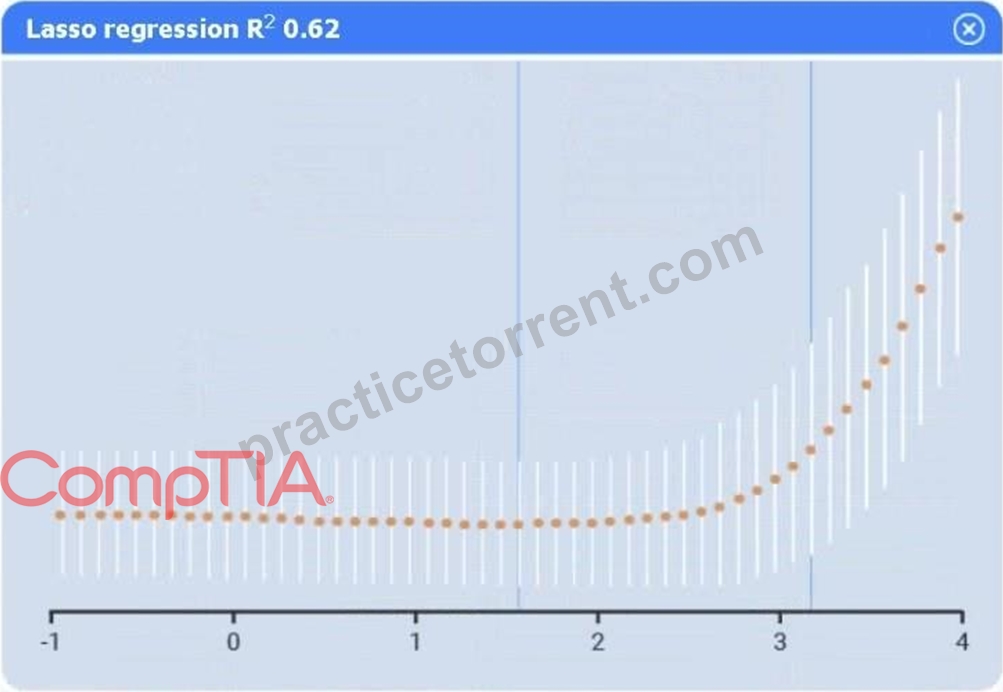
Of the four models, linear regression has the highest R² (0.8), indicating it explains the greatest proportion of variance in sales.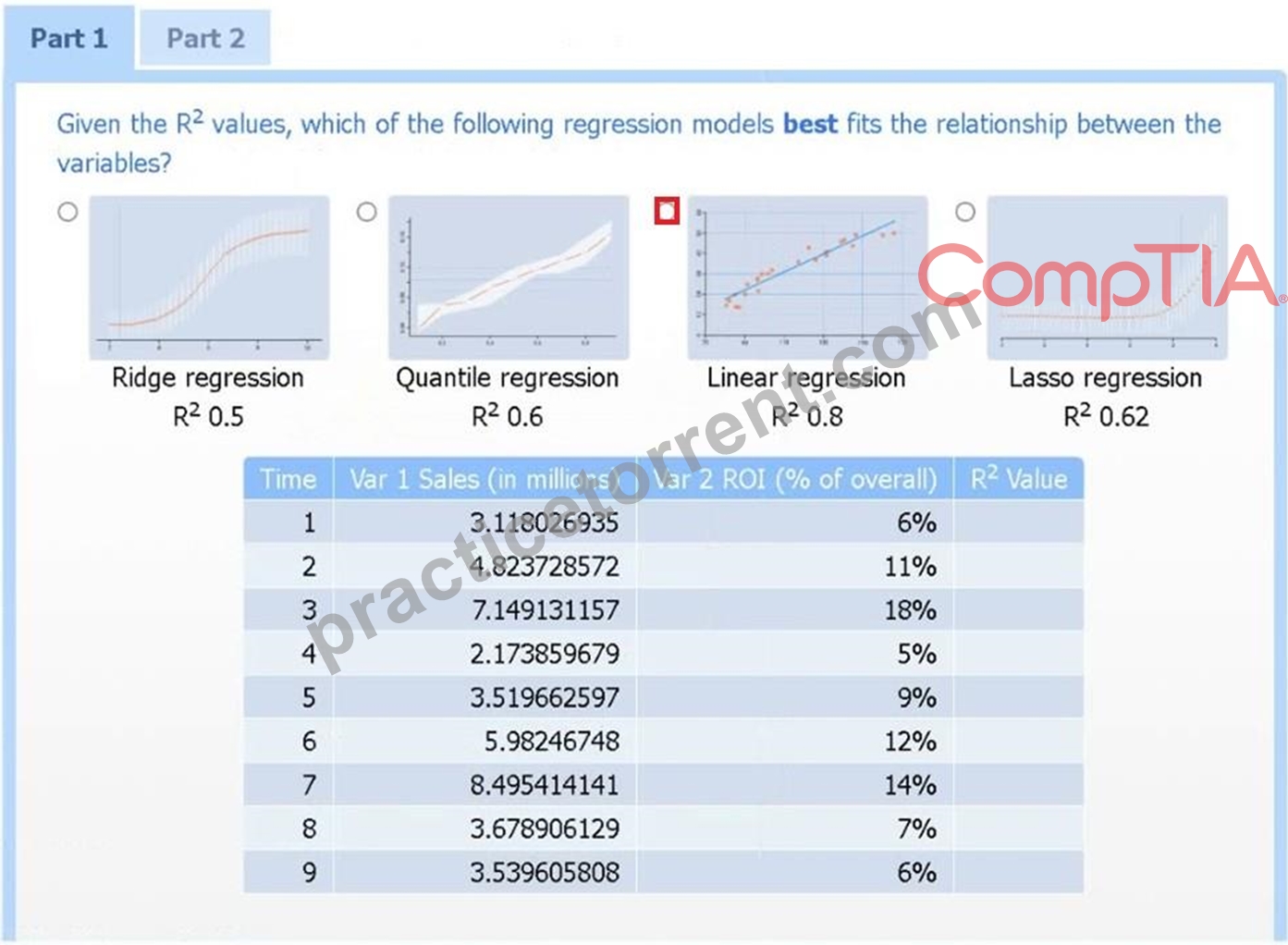
Part 2
Var 4 - Net operations cost.
Net operations cost has a p-value of essentially 0 (far below 0.05), indicating it is the only additional predictor statistically significant in explaining sales. Neither inventory cost (p≈0.90) nor initial investment (p≈0.23) reach significance.
NEW QUESTION # 34
Which of the following modeling tools is appropriate for solving a scheduling problem?
- A. Gradient descent
- B. Decision tree
- C. One-armed bandit
- D. Constrained optimization
Answer: D
Explanation:
Scheduling problems typically involve the assignment of limited resources (e.g., time, personnel, machines) over time to tasks, often under constraints. These problems are inherently mathematical and are typically solved using:
# Constrained Optimization - which is a mathematical technique for optimizing an objective function subject to one or more constraints. This tool is widely used for operations research problems such as scheduling, resource allocation, logistics, and supply chain optimization.
Why the other options are incorrect:
* A. One-armed bandit: Refers to a class of algorithms used for balancing exploration and exploitation, not scheduling.
* C. Decision tree: Used for classification and regression, not for constraint-based scheduling.
* D. Gradient descent: An optimization method for training models (typically ML), but not specifically suitable for complex constraint-based scheduling.
Official References:
* CompTIA DataX (DY0-001) Official Study Guide - Section 3.4 (Modeling Tools):"Scheduling and allocation problems are best addressed using constrained optimization techniques which allow incorporation of resource limits and goal functions."
* Data Science and Operations Research Foundations, Chapter 7:"Constraint-based optimization is the primary mathematical strategy used in scheduling problems to meet deadlines, minimize cost, or maximize throughput."
-
NEW QUESTION # 35
Given the following:
Which of the following time series models best represents this process?
- A. SARIMA(1, 1, 1) x (1, 1, 1)1
- B. ARIMA(1,1,1)
- C. AR(1)
- D. ARMA(1,1)
Answer: C
Explanation:
The model has a single autoregressive term and only white‐noise errors, matching the definition of an AR(1) process.
NEW QUESTION # 36
A data scientist is deploying a model that needs to be accessed by multiple departments with minimal development effort by the departments. Which of the following APIs would be best for the data scientist to use?
- A. RPC
- B. REST
- C. SOAP
- D. JSON
Answer: B
Explanation:
# REST (Representational State Transfer) is a web-based API style that is widely adopted for its simplicity, scalability, and use of standard HTTP methods (GET, POST, PUT, DELETE). It is stateless and can be consumed easily by multiple systems and departments with minimal integration work.
Why the other options are incorrect:
* A: SOAP is heavy, XML-based, and requires more development overhead.
* B: RPC is lower-level and not well-suited for scalable, modern web services.
* C: JSON is a data format, not an API protocol.
Official References:
* CompTIA DataX (DY0-001) Official Study Guide - Section 5.4 (API and Model Deployment):"REST APIs are preferred for exposing models to various consumers due to their simplicity, platform-agnostic nature, and use of standard HTTP."
* Data Engineering Design Patterns, Section 6:"RESTful services enable easy integration of machine learning models with front-end and enterprise systems." RESTful APIs use standard HTTP methods and lightweight data formats (typically JSON), making them easy for diverse teams to integrate with minimal effort and without heavy tooling.
NEW QUESTION # 37
A data scientist is building a model to predict customer credit scores based on information collected from reporting agencies. The model needs to automatically adjust its parameters to adapt to recent changes in the information collected. Which of the following is the best model to use?
- A. Linear discriminant analysis
- B. Decision tree
- C. XGBoost
- D. Random forest
Answer: C
Explanation:
# XGBoost (Extreme Gradient Boosting) is a high-performance, scalable ensemble algorithm that builds decision trees in sequence and adjusts to errors iteratively. It also supports incremental training, making it adaptive to changing data patterns - ideal for dynamically updated credit information.
Why the other options are incorrect:
* A: Decision trees are static once trained and don't adapt unless retrained.
* B: Random forest is an ensemble of trees but lacks the adaptive boosting component.
* C: LDA is a linear classification technique - not suited for adapting to changing data distributions.
Official References:
* CompTIA DataX (DY0-001) Official Study Guide - Section 4.3:"XGBoost is highly efficient and supports iterative learning, making it well-suited for data environments that evolve over time."
* Applied Machine Learning Guide, Chapter 8:"XGBoost adapts to changes by refining errors across iterations, providing robustness in dynamic systems."
-
NEW QUESTION # 38
A data scientist receives an update on a business case about a machine that has thousands of error codes. The data scientist creates the following summary statistics profile while reviewing the logs for each machine: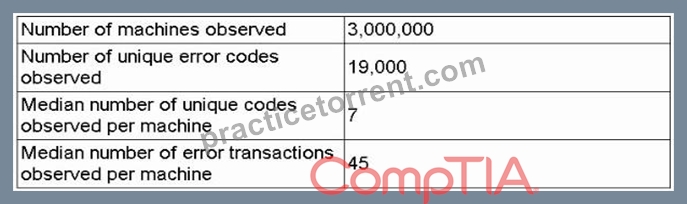
Which of the following is the most likely concern with respect to data design for model ingestion?
- A. Sparse matrix
- B. Granularity misalignment
- C. Multivariate outliers
- D. Insufficient features
Answer: A
Explanation:
With 19,000 possible error-code features and each machine reporting only a handful (median of 7), your feature matrix will be extremely sparse (most entries zero) which can negatively impact both storage and model performance unless you address it (e.g., via sparse data structures or dimensionality reduction).
NEW QUESTION # 39
A data scientist is performing a linear regression and wants to construct a model that explains the most variation in the dat a. Which of the following should the data scientist maximize when evaluating the regression performance metrics?
- A. p value
- B. R2
- C. AUC
- D. Accuracy
Answer: B
NEW QUESTION # 40
Which of the following best describes the minimization of the residual term in a ridge linear regression?
- A. e²
- B. |e|
- C. 0
- D. e
Answer: A
Explanation:
# In ridge regression, the model minimizes the sum of squared residuals (errors), with an added penalty term on the magnitude of coefficients (L2 regularization). The residual component specifically is represented by:
# e² (squared error)
Thus, ridge regression minimizes:
Minimize: #(y# # ##)² + ##(#²)
Why the other options are incorrect:
* A: |e| corresponds to L1 loss (used in Lasso).
* B: e represents the error term itself, not its minimized quantity.
* D: Zero error is ideal but practically unachievable and not the actual loss function being minimized.
Official References:
* CompTIA DataX (DY0-001) Study Guide - Section 1.4:"Ridge regression minimizes the squared error term with an L2 penalty."
* Introduction to Statistical Learning, Chapter 6:"Ridge regression uses squared error loss, which emphasizes larger deviations more heavily than linear loss."
-
NEW QUESTION # 41
Which of the following types of layers is used to downsample feature detection when using a convolutional neural network?
- A. Pooling
- B. Input
- C. Output
- D. Hidden
Answer: A
Explanation:
# Pooling layers are used in Convolutional Neural Networks (CNNs) to reduce the spatial dimensions (width and height) of the feature maps. This helps in downsampling, reducing computational complexity, and controlling overfitting by summarizing the features (e.g., max pooling or average pooling).
Why the other options are incorrect:
* B: Input layers receive raw data and do not perform downsampling.
* C: Output layers generate the final prediction.
* D: Hidden layers process data but do not specifically perform downsampling unless designed to do so (e.g., convolutional or pooling sublayers).
Official References:
* CompTIA DataX (DY0-001) Study Guide - Section 4.3:"Pooling layers are used to downsample feature maps and are critical in CNNs for reducing dimensions."
-
NEW QUESTION # 42
A data analyst wants to generate the most data using tables from a database. Which of the following is the best way to accomplish this objective?
- A. FULL OUTER JOIN
- B. RIGHT OUTER JOIN
- C. INNER JOIN
- D. LEFT OUTER JOIN
Answer: A
Explanation:
# FULL OUTER JOIN returns all rows from both tables, inserting NULLs where no match exists. This join includes the maximum possible number of records - all matches, plus all unmatched records from both sides.
Why the other options are incorrect:
* A: INNER JOIN returns only matching rows - less total data.
* B & C: LEFT/RIGHT JOIN include all rows from one table only.
Official References:
* CompTIA DataX (DY0-001) Study Guide - Section 5.2:"A FULL OUTER JOIN maximizes data volume by including all matched and unmatched records from both tables."
* SQL for Data Science, Chapter 4:"Use FULL OUTER JOIN when the goal is to preserve every record from both datasets regardless of match."
-
NEW QUESTION # 43
A data scientist is analyzing a data set with categorical features and would like to make those features more useful when building a model. Which of the following data transformation techniques should the data scientist use? (Choose two.)
- A. One-hot encoding
- B. Label encoding
- C. Pivoting
- D. Scaling
- E. Normalization
- F. Linearization
Answer: A
Explanation:
One-hot encoding creates binary indicator columns for each category, allowing models to treat nominal categories without implying any order.
Label encoding maps categories to integer labels, which can be useful for tree-based models or when you need a single numeric column (though you must ensure the algorithm can handle treated ordinality appropriately).
NEW QUESTION # 44
......
Get Special Discount Offer of DY0-001 Certification Exam Sample Questions and Answers: https://actual4test.practicetorrent.com/DY0-001-practice-exam-torrent.html