


Latest Success Metrics For Actual HPE7-A02 Exam 2025 Realistic Dumps
Updated HPE7-A02 Dumps Questions For HP Exam
The HP HPE7-A02 exam is aimed at IT professionals who have experience working with Aruba products and solutions and are familiar with wireless network technologies. Aruba Certified Network Security Professional Exam certification is ideal for network administrators, security professionals, and IT managers who are responsible for ensuring the security and reliability of their organization's wireless network infrastructure.
NEW QUESTION # 34
A company is using HPE Aruba Networking ClearPass Device Insight (CPDI) (the standalone application).
You have identified a device, which is currently
classified as one type, but you want to classify it as a custom type. You also want to classify all devices with similar attributes as this type, both already-discovered devices and new devices discovered later.
What should you do?
- A. In the device details, select reclassify, create a user rule based on its attributes, and choose "Save & Reclassify."
- B. Create a user rule from the Generic Devices page, select the desired attributes for the rule, and choose
"Save." - C. Create a user tag from the Generic Devices page, select the desired attributes for the tag, and save the tag.
- D. In the device details, select filter, create a user tag based on the device attributes, and save the tag.
Answer: A
Explanation:
When using HPE Aruba Networking ClearPass Device Insight (CPDI) and you need to reclassify a device to a custom type and apply this classification to all devices with similar attributes, both already discovered and newly discovered, you should follow these steps:
1.Navigate to the device details in CPDI.
2.Select the option to reclassify the device.
3.Create a user rule based on the desired attributes of the device.
4.Choose the "Save & Reclassify" option.
This process ensures that the device is reclassified according to the new custom type and that the rule is applied to all existing and future devices with matching attributes, maintaining consistent classification across the network.
NEW QUESTION # 35
An AOS-CX switch has been configured to implement UBT to a cluster of three HPE Aruba Networking gateways.
How does the switch determine to which gateways to tunnel UBT users' traffic?
- A. The switch tunnels all users' traffic to the gateway assigned as the switch's active device designated gateway.
- B. The switch tunnels each user's traffic to the particular gateway assigned as that user's active user designed gateway.
- C. The switch tunnels all users' traffic to the gateway configured as the primary gateway in the UBT zone, unless that gateway fails.
- D. The switch load balances client traffic across the primary and standby gateway configured in the UBT zone.
Answer: B
Explanation:
When an AOS-CX switch implements User-Based Tunneling (UBT) to a cluster of three HPE Aruba Networking gateways, the switch determines to which gateway to tunnel each user's traffic based on the particular gateway assigned as that user's active user designated gateway. This ensures that traffic is efficiently distributed and managed according to the designated gateway for each user.
1.User Designated Gateway: Each user's traffic is tunneled to a specific gateway that has been designated for that user, ensuring efficient handling of traffic.
2.Traffic Distribution: This method allows for balanced distribution of user traffic across multiple gateways, enhancing network performance and reliability.
3.Gateway Assignment: The switch uses the assigned gateway for each user to determine the tunneling path, ensuring that traffic is directed to the appropriate gateway.
NEW QUESTION # 36
Assume that an AOS-CX switch is already implementing DHCP snooping and ARP inspection successfully on several VLANs.
What should you do to help minimize disruption time if the switch reboots?
- A. Create static IP-to-MAC bindings for the DHCP and DNS servers.
- B. Save the IP-to-MAC bindings to external storage.
- C. Configure the switch to act as an ARP proxy.
- D. Configure the IP helper address on this switch, rather than a core routing switch.
Answer: B
Explanation:
To minimize disruption time if an AOS-CX switch reboots while implementing DHCP snooping and ARP inspection, you should save the IP-to-MAC bindings to external storage. This ensures that the DHCP snooping and ARP inspection tables, which are crucial for preventing spoofing attacks, are preserved across reboots. When the switch restarts, it can reload these bindings from the external storage, thereby maintaining network security and reducing the downtime associated with rebuilding these tables.
1.Preserving Bindings: Saving IP-to-MAC bindings to external storage ensures that these critical security tables are not lost during a reboot, maintaining network integrity.
2.Security Continuity: This practice helps to quickly restore security features like DHCP snooping and ARP inspection, minimizing the window of vulnerability.
3.Operational Efficiency: By preserving these bindings, the switch can resume normal operations faster, reducing disruption to network services.
NEW QUESTION # 37
The security team needs you to show them information about MAC spoofing attempts detected by HPE Aruba Networking ClearPass Policy Manager (CPPM).
What should you do?
- A. Export the Access Tracker records on CPPM as an XML file.
- B. Integrate CPPM with ClearPass Device Insight (CPDI) and run a security report on CPDI.
- C. Use ClearPass Insight to run an Active Endpoint Security report.
- D. Show the security team the CPPM Endpoint Profiler dashboard.
Answer: C
Explanation:
To show the security team information about MAC spoofing attempts detected by HPE Aruba Networking ClearPass Policy Manager (CPPM), you should use ClearPass Insight to run an Active Endpoint Security report. ClearPass Insight provides comprehensive reporting capabilities that include detailed information on security incidents, such as MAC spoofing attempts. By generating this report, you can provide the security team with a clear overview of the detected spoofing activities, including the endpoints involved and the context of the events.
NEW QUESTION # 38
A company assigns a different block of VLAN IDs to each of its access layer AOS-CX switches. The switches run version 10.07. The IDs are used for standard purposes, such as for employees, VolP phones, and cameras. The company wants to apply 802.1X authentication to HPE Aruba Networking ClearPass Policy Manager (CPPM) and then steer clients to the correct VLANs for local forwarding.
What can you do to simplify setting up this solution?
- A. Use the trunk allowed VLAN setting to assign multiple VLAN IDs to the same role.
- B. Assign consistent names to VLANs of the same type across the AOS-CX switches and have user-roles reference names.
- C. Change the VLAN IDs across the AOS-CX switches so that they are consistent.
- D. Avoid configuring the VLAN in the role; use trunk VLANs to assign multiple VLANs to the port instead.
Answer: B
Explanation:
To simplify the setup of 802.1X authentication with HPE Aruba Networking ClearPass Policy Manager (CPPM) and ensure clients are steered to the correct VLANs for local forwarding, you should assign consistent names to VLANs of the same type across the AOS-CX switches and have user-roles reference these names. This approach allows for a more straightforward configuration and management process, as the user roles can apply consistent policies based on VLAN names rather than specific IDs. It also helps in maintaining clarity and reducing errors in VLAN assignments across different switches.
NEW QUESTION # 39
A company wants to apply a standard configuration to all AOS-CX switch ports and have the ports dynamically adjust their configuration based on the identity of the user or device that connects. They want to centralize configuration of the identity-based settings as much as possible.
What should you recommend?
- A. Having switches download user-roles from HPE Aruba Networking gateways
- B. Having switches download user-roles from HPE Aruba Networking ClearPass Policy Manager (CPPM)
- C. Having HPE Aruba Networking ClearPass Policy Manager (CPPM) send standard RADIUS AVPs to customize port settings
- D. Having switches pull port configurations dynamically from HPE Aruba Networking Activate
Answer: B
Explanation:
For a company that wants to apply a standard configuration to all AOS-CX switch ports and dynamically adjust their configuration based on the identity of the user or device that connects, the best approach is to have the switches download user-roles from HPE Aruba Networking ClearPass Policy Manager (CPPM).
This method centralizes the configuration of identity-based settings in CPPM, allowing it to dynamically assign roles and policies to switch ports based on authentication and authorization results. This ensures consistent and secure network access control tailored to each user or device.
NEW QUESTION # 40 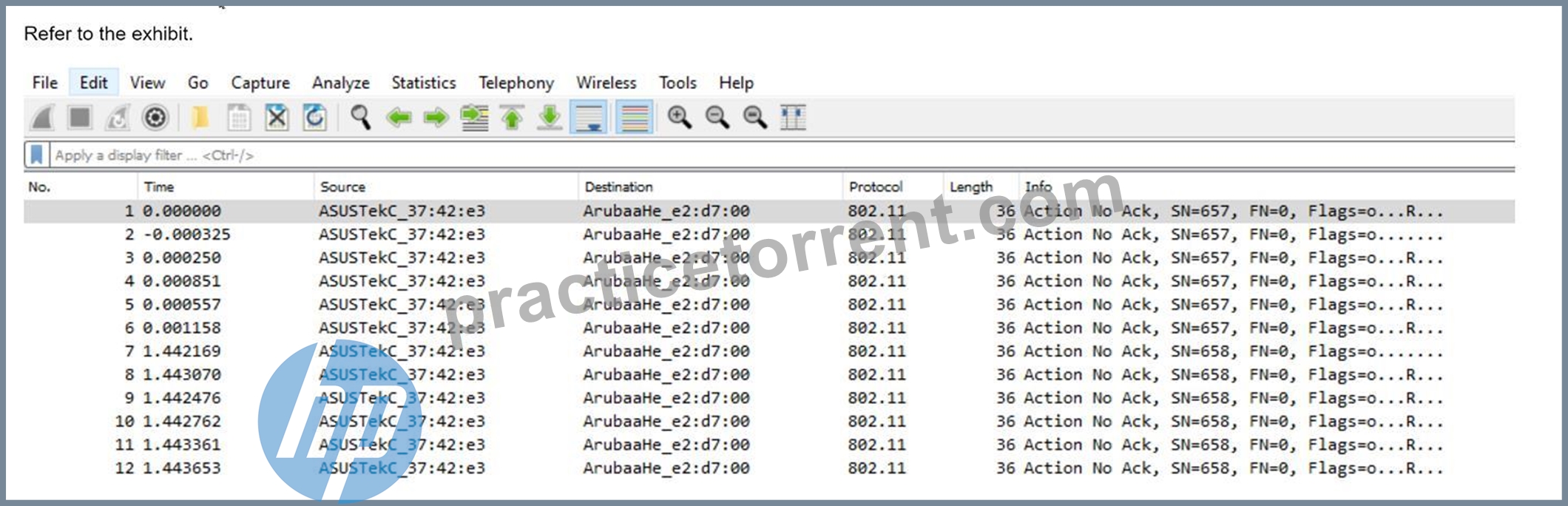
You have downloaded a packet capture that you generated on HPE Aruba Networking Central. When you open the capture in Wireshark, you see the output shown in the exhibit.
What should you do in Wireshark so that you can better interpret the packets?
- A. Edit preferences for IEEE 802.11 and chose to ignore the Protection bit with IV.
- B. Choose to decode UDP port 5555 packets as ARUBA_ERM and set the Aruba ERM Type to 0.
- C. Apply the following display filter: wlan.fc.type == 1.
- D. Edit the Enabled Protocols and make sure that 802.11, GRE, and Aruba_ERM are enabled.
Answer: B
Explanation:
To better interpret the packets shown in the Wireshark capture, you should choose to decode UDP port 5555 packets as ARUBA_ERM and set the Aruba ERM Type to 0. This configuration will allow Wireshark to properly decode and display the Aruba-specific encapsulated remote mirroring (ERM) packets, providing a clearer understanding of the traffic.
1.Decoding Protocols: Selecting the correct protocol decoding in Wireshark ensures that the captured packets are interpreted correctly, displaying the relevant information.
2.Aruba ERM: The packets in the capture are likely encapsulated remote mirroring (ERM) packets specific to Aruba, which require proper decoding settings in Wireshark.
3.Clear Interpretation: By setting the Aruba ERM Type to 0 and decoding the packets as ARUBA_ERM, you can view the encapsulated data accurately.
NEW QUESTION # 41
A company is implementing a client-to-site VPN based on tunnel-mode IPsec.
Which devices are responsible for the IPsec encapsulation?
- A. The remote clients and devices accessed by the clients at the main site
- B. Gateways at the remote clients' locations and a gateway at the main site
- C. Gateways at the remote clients' locations and devices accessed by the clients at the main site
- D. The remote clients and a gateway at the main site
Answer: D
Explanation:
In a client-to-site VPN based on tunnel-mode IPsec, the remote clients and a gateway at the main site are responsible for the IPsec encapsulation. The remote clients initiate the VPN connection and encapsulate their traffic in IPsec, which is then decapsulated by the gateway at the main site.
1.IPsec Encapsulation: The remote clients encapsulate their traffic using IPsec protocols before sending it over the internet to the main site.
2.Gateway Role: The gateway at the main site receives the encapsulated traffic, decapsulates it, and forwards it to the internal network. Similarly, traffic from the main site to the remote clients is encapsulated by the gateway and decapsulated by the clients.
3.Security: This setup ensures that data is securely transmitted between the remote clients and the main site, protecting it from eavesdropping and tampering.
NEW QUESTION # 42
Refer to the exhibit.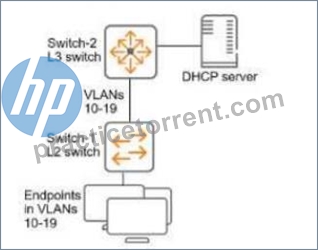
You have verified that AOS-CX Switch-1 has constructed an IP-to-MAC binding table in VLANs 10-19.
Now you need to enable ARP inspection for the endpoint connected to Switch-1. What must you do first to prevent traffic disruption?
- A. Configure Switch-1 uplinks as trusted ARP inspection ports.
- B. Configure DHCP snooping on VLANs 10-19 on Switch-2.
- C. Configure ARP inspection on VLANs 10-19 on Switch-2.
- D. Create a static IP-to-MAC binding on Switch-1 for the DHCP server.
Answer: A
Explanation:
Dynamic ARP Inspection (DAI):
* ARP inspection verifies ARP packets against a trusted IP-to-MAC binding table to prevent ARP spoofing attacks.
* DHCP snooping is required to construct the IP-to-MAC binding table dynamically.
* To avoid traffic disruption, uplink ports that connect to trusted switches, DHCP servers, or routers must be explicitly configured as trusted ports for ARP inspection.
Steps to Prevent Traffic Disruption:
* Trust the Uplinks: ARP inspection must treat uplink ports as trusted to allow ARP traffic from legitimate DHCP servers and upstream switches.
* Enable DHCP Snooping: DHCP snooping must be enabled on Switch-2 to ensure consistent IP-to- MAC bindings upstream.
Why the Answer is Correct:
* Option A: Incorrect. ARP inspection on Switch-2 is important but not required first to prevent disruption on Switch-1.
* Option B: Incorrect. DHCP snooping must be enabled upstream eventually, but this alone will not stop immediate traffic disruption on Switch-1.
* Option C: Correct. Switch-1 uplinks must be trusted ARP inspection ports first to allow legitimate upstream traffic and prevent ARP disruption.
* Option D: Incorrect. Static bindings are not required if DHCP snooping is enabled, and they are manual, limiting scalability.
Conclusion:
To avoid traffic disruption, configure Switch-1 uplinks as trusted ARP inspection ports to ensure valid ARP traffic can pass upstream and downstream.
NEW QUESTION # 43
You are establishing a cluster of HPE Aruba Networking ClearPass servers. (Assume that they are running version 6.9.).
For which type of certificate it is recommended to install a CA-signed certificate on the Subscriber before it joins the cluster?
- A. Database
- B. HTTPS
- C. RADIUS/EAP
- D. RadSec
Answer: B
Explanation:
When establishing a cluster of HPE Aruba Networking ClearPass servers, it is recommended to install a CA-signed certificate for HTTPS on the Subscriber before it joins the cluster. This ensures secure communication between the servers in the cluster and provides a trusted certificate for client connections.
1.HTTPS Security: A CA-signed certificate for HTTPS ensures that all web-based communication to and from the ClearPass server is encrypted and secure.
2.Cluster Communication: Secure communication between ClearPass nodes in the cluster is essential for synchronization and data integrity.
3.Client Trust: Clients accessing the ClearPass server will trust the CA-signed certificate, avoiding security warnings and ensuring smooth operations.
NEW QUESTION # 44
You are deploying a virtual Data Collector for use with HPE Aruba Networking ClearPass Device Insight (CPDI). You have identified VLAN 101 in the data center as the VLAN to which the Data Collector should connect to receive its IP address and connect to HPE Aruba Networking Central.
Which Data Collector virtual ports should you tell the virtual admins to connect to VLAN 101?
- A. The one with the highest port ID
- B. The one with the highest MAC address
- C. The one with the lowest MAC address
- D. The one with the lowest port ID
Answer: D
Explanation:
When deploying a virtual Data Collector for HPE Aruba Networking ClearPass Device Insight (CPDI), it is essential to ensure that the correct virtual port is connected to the designated VLAN. In this case, VLAN 101 is used to receive the IP address and connect to Aruba Central. The best practice is to use the virtual port with the lowest port ID. This is typically the primary port used for management and network connectivity in virtual environments, ensuring proper network integration and communication.
NEW QUESTION # 45
A company wants to turn on Wireless IDS/IPS infrastructure and client detection at the high level on HPE Aruba Networking APs. The company does not want to enable any prevention settings.
What should you explain about HPE Aruba Networking recommendations?
- A. HPE Aruba Networking recommends using hybrid AP mode, as opposed to Air Monitors (AMs), when implementing detection without prevention.
- B. HPE Aruba Networking recommends disabling client detection when you configure infrastructure detection at high, as infrastructure detection includes all the client checks and more.
- C. HPE Aruba Networking recommends turning on both wired and wireless prevention whenever you enable detection at high.
- D. HPE Aruba Networking recommends configuring infrastructure and client detection at a custom level and disabling or tuning some of the settings that are likely to produce false positives.
Answer: D
Explanation:
When enabling Wireless IDS/IPS infrastructure and client detection at a high level on HPE Aruba Networking APs without enabling prevention settings, HPE Aruba Networking recommends configuring detection at a custom level and adjusting settings to minimize false positives. This approach allows for effective monitoring while reducing the risk of unnecessary alerts and maintaining the accuracy of detections.
1.Custom Level Configuration: By customizing the detection settings, you can tailor the system to your specific environment, ensuring that only relevant threats are detected and reducing false positives.
2.False Positive Reduction: Disabling or tuning settings that are likely to produce false positives helps in maintaining the reliability of the detection system and prevents alert fatigue.
3.Focused Detection: Custom configuration ensures that the IDS/IPS focuses on critical detections, improving overall security posture.
NEW QUESTION # 46
A company has AOS-CX switches and HPE Aruba Networking ClearPass Policy Manager (CPPM). The company wants switches to implement 802.1X authentication to CPPM and download user roles.
What is one task that you must complete on the switches to support this use case?
- A. Specify a ClearPass username and password that match the name and RADIUS secret in a CPPM network device entry.
- B. Specify CPPM as the RADIUS server with the exact CN in CPPM's HTTPS certificate.
- C. Install the root CA certificate for CPPM's RADIUS certificate in a TA profile on the switches.
- D. Configure empty user-roles with names that match enforcement profile names on CPPM.
Answer: C
Explanation:
To support 802.1X authentication and download user roles from HPE Aruba Networking ClearPass Policy Manager (CPPM) on AOS-CX switches, you must install the root CA certificate for CPPM's RADIUS certificate in a Trust Anchor (TA) profile on the switches. This ensures that the switches trust the RADIUS server certificate presented by CPPM during the authentication process.
1.Root CA Certificate: Installing the root CA certificate ensures that the switch can verify the authenticity of the RADIUS server certificate provided by CPPM.
2.Trust Anchor Profile: The TA profile on the switch holds the root CA certificate, establishing a trust relationship between the switch and the CPPM RADIUS server.
3.Secure Authentication: This setup is essential for securing the 802.1X authentication process and enabling the download of user roles.
NEW QUESTION # 47
A company has HPE Aruba Networking Central-managed APs. The company wants to block all clients connected through the APs from using YouTube.
Which steps should you take?
- A. Enable WebCC on all client firewall roles. Then, create WebCC category rules that deny suspicious URLs.
- B. Deploy gateways and have the APs tunnel traffic to the gateways. Then, enable the gateway IDS/IPS engine.
- C. Enable Client IPS at the "custom" level, and then specify the check for YouTube.
- D. Enable DPI. Then, create application rules to deny YouTube on the firewall roles.
Answer: D
Explanation:
To block all clients connected through HPE Aruba Networking Central-managed APs from accessing YouTube, you should enable DPI (Deep Packet Inspection) and then create application rules to deny YouTube on the firewall roles. DPI allows the network to inspect and classify traffic based on application signatures, making it possible to enforce application-specific policies. By creating rules that specifically block YouTube traffic, you can effectively prevent clients from accessing the service.
NEW QUESTION # 48
A company has an HPE Aruba Networking ClearPass cluster with several servers. ClearPass Policy Manager (CPPM) is set up to:
. Update client attributes based on Syslog messages from third-party appliances
. Have the clients reauthenticate and apply new profiles to the clients based on the updates To ensure that the correct profiles apply, what is one step you should take?
- A. Set the cluster's Endpoint Context Servers polling interval to a value of 5 seconds or less.
- B. Configure the cluster to periodically clean up (delete) unknown endpoints.
- C. Tune the CoA delay on the ClearPass servers to a value of 5 seconds or greater.
- D. Configure a CoA action for all tag updates in the ClearPass Device Insight integration settings.
Answer: C
Explanation:
To ensure that the correct profiles apply after client attributes are updated based on Syslog messages, you should tune the Change of Authorization (CoA) delay on the ClearPass servers to a value of 5 seconds or greater. This delay allows sufficient time for the attribute updates to be processed and for the reauthentication to occur correctly, ensuring that the updated profiles are accurately applied to the clients.
1.CoA Delay: Adjusting the CoA delay ensures that the system has enough time to update client attributes and reauthenticate them properly before applying new profiles.
2.Profile Accuracy: This delay helps in preventing premature reauthentication and ensures that the most recent attribute updates are considered when applying profiles.
3.System Synchronization: Ensures synchronization between the attribute update and the reauthentication process.
NEW QUESTION # 49
Which use case is fulfilled by applying a time range to a firewall rule on an AOS device?
- A. Locking clients that violate the rule for the specified time range
- B. Enforcing the rule only during the specified time range
- C. Setting the time range over which hit counts for the rule are aggregated
- D. Tuning the session timeout for sessions established with this rule
Answer: B
Explanation:
Applying a time range to a firewall rule on an AOS device fulfills the use case of enforcing the rule only during the specified time range. This allows administrators to control when specific firewall rules are active, which can be useful for implementing policies that only need to be in effect during certain hours, such as blocking or allowing access to specific resources outside of business hours.
1.Time-Based Enforcement: The firewall rule will be active only during the specified time range, ensuring that the rule's policies are enforced only when needed.
2.Use Case: This feature is useful for scenarios like limiting access to certain applications or websites during working hours, or enabling enhanced security measures during off-hours.
3.Flexibility: Provides flexibility in security policy management by allowing dynamic adjustment of rules based on time schedules.
NEW QUESTION # 50
A company already uses HPE Aruba Networking ClearPass Policy Manager (CPPM) as the RADIUS server for authenticating wireless clients with 802.1X. Now you are setting up 802.1X on AOS-CX switches to authenticate many of those same clients on wired connections. You decide to copy CPPM's wireless 802.1X service and then edit it with a new name and enforcement policy. What else must you change for authentication to work properly?
- A. Authentication source
- B. Authentication methods
- C. Service rules
- D. Role mapping policy
Answer: C
Explanation:
* 802.1X Service Rules:
* Service rules define the criteria for when a specific service applies (e.g., wireless vs. wired authentication).
* For wired 802.1X authentication to work properly, the service rules need to differentiate between wireless and wired connections.
* If you copy the wireless service, the rules likely still match wireless-specific criteria. These must be updated to include wired-specific conditions (e.g., NAS IP or port types).
* Option Analysis:
* Option A (Role mapping policy): Role mapping policies determine user roles based on attributes but are not critical for differentiating wired vs. wireless.
* Option B (Authentication methods): Authentication methods (e.g., EAP) remain the same for both wireless and wired 802.1X.
* Option C (Authentication source): Authentication sources (like AD or internal database) do not need to change.
* Option D (Service rules): Correct. Updating the service rules ensures the new 802.1X service applies specifically to wired connections.
NEW QUESTION # 51
What is one benefit of integrating HPE Aruba Networking ClearPass Policy Manager (CPPM) with third-party solutions such as Mobility Device Management (MDM) and firewalls?
- A. CPPM can offload policy decisions to the third-party solutions, enabling CPPM to respond to authentication requests more quickly.
- B. CPPM can exchange contextual information about clients with third-party solutions, which helps make better decisions.
- C. CPPM can take over filtering internal traffic so that the third-party solutions have more processing power to devote to filtering external traffic.
- D. CPPM can make the third-party solutions more secure by adding signature-based threat detection capabilities.
Answer: B
Explanation:
* Contextual Exchange for Better Decisions:
* HPE Aruba ClearPass can integrate with third-party solutions like MDM and firewalls to exchange contextual information about endpoints (e.g., device type, posture, location).
* This integration allows ClearPass and the third-party solutions to make better access control and security decisions.
* For example:
* An MDM can inform CPPM about device compliance, and CPPM can adjust enforcement policies dynamically.
* Firewalls can receive updated context about users and devices to enforce policies more effectively.
* Option Analysis:
* Option A: Correct. Exchanging contextual information improves access control decisions.
* Option B: Incorrect. CPPM does not provide signature-based threat detection.
* Option C: Incorrect. CPPM does not offload policy decisions; it integrates for collaboration.
* Option D: Incorrect. CPPM does not replace third-party traffic filtering capabilities.
NEW QUESTION # 52
What is one use case for implementing user-based tunneling (UBT) on AOS-CX switches?
- A. Tunneling traffic directly to a third-party firewall in a client data center
- B. Applying enhanced security features such as deep packet inspection (DPI) to wired traffic
- C. Adding 802.1X while continuing to use the existing VLAN and ACL structure in the Ethernet network
- D. Centralizing the distribution of wired traffic without requiring HPE Aruba Networking gateways
Answer: B
Explanation:
Implementing user-based tunneling (UBT) on AOS-CX switches is beneficial for applying enhanced security features such as deep packet inspection (DPI) to wired traffic. UBT allows the traffic from specific users or devices to be tunneled to a central controller or security appliance where advanced security policies, including DPI, can be applied. This approach ensures that even wired traffic benefits from the same level of security and inspection typically available for wireless traffic, thus enhancing overall network security.
NEW QUESTION # 53
A company uses HPE Aruba Networking ClearPass Policy Manager (CPPM) and HPE Aruba Networking ClearPass Device Insight (CPDI) and has integrated the two. CPDI admins have created a tag. CPPM admins have created rules that use that tag in the wired 802.1X and wireless 802.1X services' enforcement policies.
The company requires CPPM to apply the tag-based rules to a client directly after it learns that the client has that tag.
What is one of the settings that you should verify on CPPM?
- A. The "Device Sync" setting is set to 1 in the ClearPass Device Insight Integration settings.
- B. Both 802.1X services have the "Use cached Role and Posture attributes from the previous sessions" setting.
- C. The "Polling Interval" is set to 1 in the ClearPass Device Insight Integration settings.
- D. Both 802.1X services have the "Profile Endpoints" option enabled and an appropriate CoA profile selected in the Profiler tab.
Answer: D
Explanation:
To ensure that HPE Aruba Networking ClearPass Policy Manager (CPPM) applies tag-based rules to a client immediately after learning the client has that tag, verify that both 802.1X services have the "Profile Endpoints" option enabled and an appropriate Change of Authorization (CoA) profile selected in the Profiler tab. This setup ensures that when a device is profiled and tagged, CPPM can immediately enforce the updated policies through CoA.
1.Profile Endpoints: Enabling this option ensures that endpoint profiling is active, allowing CPPM to gather and use device information dynamically.
2.CoA Profile: Selecting an appropriate CoA profile ensures that CPPM can push policy changes immediately to the network devices, applying the new rules without delay.
3.Real-Time Enforcement: This configuration allows for the immediate application of new tags and associated policies, ensuring compliance with security requirements.
NEW QUESTION # 54
You are establishing a cluster of HPE Aruba Networking ClearPass servers. (Assume that they are running version 6.9.).
For which type of certificate is it recommended to install a CA-signed certificate on the Subscriber before it joins the cluster?
- A. Database
- B. HTTPS
- C. RADIUS/EAP
- D. RadSec
Answer: B
Explanation:
When setting up a ClearPass cluster, it is critical to ensure secure communication between the cluster nodes and the client devices. For this purpose, certain certificates must be properly configured.
1. Why HTTPS Requires a CA-Signed Certificate?
* HTTPS communication is used for inter-cluster communication and for the web-based user interface that administrators use to manage the ClearPass cluster.
* Before joining the cluster, it is strongly recommended to install a CA-signed HTTPS certificate on the Subscriber to ensure secure communication and prevent warnings/errors due to untrusted certificates.
* Without a CA-signed certificate, the Subscriber might use a self-signed certificate, leading to security risks and lack of trust validation.
2. Analysis of Other Certificate Types
* B. Database:
* Incorrect: Database communications within ClearPass clusters are secured using internal certificates or keys. These are not user-facing and do not require a CA-signed certificate before joining the cluster.
* C. RADIUS/EAP:
* Incorrect: RADIUS/EAP certificates are important for client authentication, but they are not required on the Subscriber prior to cluster joining. These can be configured after the Subscriber is part of the cluster.
* D. RadSec:
* Incorrect: RadSec is an optional feature for secure RADIUS communication over TLS, and its certificate configuration is typically performed post-cluster setup.
Final Recommendation
To ensure secure cluster operations and seamless web-based management, a CA-signed HTTPS certificate should be installed on the Subscriber before it joins the ClearPass cluster.
References
* ClearPass Deployment Guide for Version 6.9.
* Best Practices for Certificate Management in ClearPass Clusters.
* HPE Aruba ClearPass Cluster Configuration Guide.
NEW QUESTION # 55 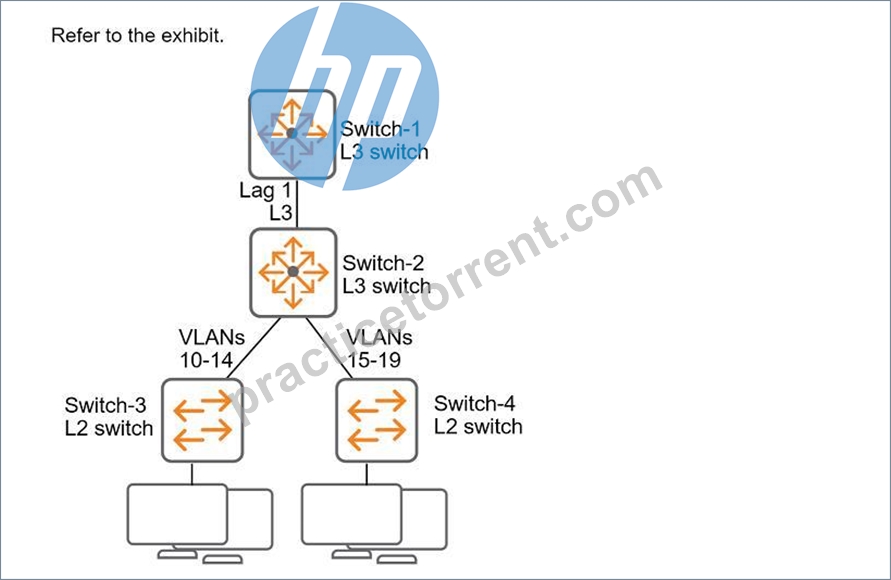
All of the switches in the exhibit are AOS-CX switches.
What is the preferred configuration on Switch-2 for preventing rogue OSPF routers in this network?
- A. Configure OSPF authentication on Lag 1 in MD5 mode.
- B. Configure OSPF authentication on VLANs 10-19 in password mode.
- C. Disable OSPF entirely on VLANs 10-19.
- D. Configure passive-interface as the OSPF default and disable OSPF passive on Lag 1.
Answer: A
Explanation:
To prevent rogue OSPF routers in the network shown in the exhibit, the preferred configuration on Switch-2 is to configure OSPF authentication on Lag 1 in MD5 mode. This setup enhances security by ensuring that only routers with the correct MD5 authentication credentials can participate in the OSPF routing process.
This method protects the OSPF sessions against unauthorized devices that might attempt to introduce rogue routing information into the network.
1.OSPF Authentication: Implementing MD5 authentication on Lag 1 ensures that OSPF updates are secured with a cryptographic hash. This prevents unauthorized OSPF routers from establishing peering sessions and injecting potentially malicious routing information.
2.Secure Communication: MD5 authentication provides a higher level of security compared to simple password authentication, as it uses a more robust hashing algorithm.
3.Applicability: Lag 1 is the primary link between Switch-1 and Switch-2, and securing this link helps protect the integrity of the OSPF routing domain.
NEW QUESTION # 56
......
The Aruba Certified Network Security Professional certification is highly regarded in the industry as it demonstrates an individual's ability to implement advanced security measures in a network. Aruba Certified Network Security Professional Exam certification is ideal for professionals who are responsible for securing enterprise networks. The HPE7-A02 exam is also relevant for IT professionals who work with Aruba's ClearPass Policy Manager and VPN technologies.
HPE7-A02 certification program is recognized globally and is highly valued in the IT industry. Aruba Certified Network Security Professional Exam certification program is designed to help IT professionals enhance their skills and knowledge in network security, which can help them secure better job opportunities and higher salaries. Aruba Certified Network Security Professional Exam certification program is also beneficial for organizations that are looking to hire qualified and skilled network security professionals to protect their networks against cyber-attacks.
Full HPE7-A02 Practice Test and 130 Unique Questions, Get it Now!: https://actual4test.practicetorrent.com/HPE7-A02-practice-exam-torrent.html