


2026 Updated SC-200 Tests Engine pdf - All Free Dumps Guaranteed!
Latest Microsoft Certified: Security Operations Analyst Associate SC-200 Actual Free Exam Questions
A brief introduction of Microsoft SC-200 Exam
Microsoft Security Operations Analyst Certification, often referred to as Microsoft SC-200 Exam is one of the most important courses among other courses provided by Microsoft. The course focuses on Security Analysis and Design, which is a very important factor in Network Administration. This helps us to create a secure environment for our organization. This certification provides you with the skills necessary to plan, deploy and monitor security solutions in an enterprise environment and also the skills required to administer and manage the computer security infrastructure. It gives you an edge over other candidates in terms of skill set and makes you more competitive in the job market of today's time. The course helps you understand how to plan, deploy and monitor security solutions in an enterprise environment and also how to administer and manage the computer security infrastructure. SC-200 Dumps is designed to make your Microsoft SC-200 certification preparation easy and fast.
It gives you an edge over other candidates in terms of skill-set and makes you more competitive in the job market of today's time. SC-200 exam validates your ability to design, deploy, manage and monitor a security infrastructure for a private or public organization. The exam measures your knowledge of risk management; incident response; compliance with privacy laws; data protection; cryptography, access control; business continuity planning; auditing & monitoring; intrusion detection & prevention systems (IDS/IPS); web application firewall.
The SC-200 certification exam is a challenging but rewarding opportunity for security professionals who are looking to take their careers to the next level. With the right preparation and dedication, candidates can successfully pass the exam and achieve this valuable certification.
Microsoft SC-200 certification exam covers a wide range of topics, including security fundamentals, threat intelligence, security operations, incident response, and governance, risk, and compliance (GRC). It also includes practical scenarios that simulate real-world security incidents and require you to apply your knowledge and skills to identify, investigate, and respond to security threats. SC-200 exam format is multiple-choice, and you will have 180 minutes to complete it.
NEW QUESTION # 25
You need to create the test rule to meet the Azure Sentinel requirements. What should you do when you create the rule?
- A. From Set rule logic, map the entities.
- B. From Set rule logic, turn off suppression.
- C. From Analytics rule details, configure the tactics.
- D. From Analytics rule details, configure the severity.
Answer: A
Explanation:
Reference:
https://docs.microsoft.com/en-us/azure/sentinel/tutorial-detect-threats-custom
Topic 1, Litware inc.
Overview
This is a case study. Case studies are not timed separately. You can use as much exam time as you would like to complete each case. However, there may be additional case studies and sections on this exam. You must manage your time to ensure that you are able to complete all questions included on this exam in the time provided.
To answer the questions included in a case study, you will need to reference information that is provided in the case study. Case studies might contain exhibits and other resources that provide more information about the scenario that is described in the case study. Each question is independent of the other questions in this case study.
At the end of this case study, a review screen will appear. This screen allows you to review your answers and to make changes before you move to the next section of the exam. After you begin a new section, you cannot return to this section.
To start the case study
To display the first question in this case study, click the Next button. Use the buttons in the left pane to explore the content of the case study before you answer the questions. Clicking these buttons displays information such as business requirements, existing environment, and problem statements. If the case study has an All Information tab, note that the information displayed is identical to the information displayed on the subsequent tabs. When you are ready to answer a question, click the Question button to return to the question.
Overview
Litware Inc. is a renewable company.
Litware has offices in Boston and Seattle. Litware also has remote users located across the United States. To access Litware resources, including cloud resources, the remote users establish a VPN connection to either office.
Existing Environment
Identity Environment
The network contains an Active Directory forest named litware.com that syncs to an Azure Active Directory (Azure AD) tenant named litware.com.
Microsoft 365 Environment
Litware has a Microsoft 365 E5 subscription linked to the litware.com Azure AD tenant. Microsoft Defender for Endpoint is deployed to all computers that run Windows 10. All Microsoft Cloud App Security built-in anomaly detection policies are enabled.
Azure Environment
Litware has an Azure subscription linked to the litware.com Azure AD tenant. The subscription contains resources in the East US Azure region as shown in the following table.
Network Environment
Each Litware office connects directly to the internet and has a site-to-site VPN connection to the virtual networks in the Azure subscription.
On-premises Environment
The on-premises network contains the computers shown in the following table.
Current problems
Cloud App Security frequently generates false positive alerts when users connect to both offices simultaneously.
Planned Changes
Litware plans to implement the following changes:
Create and configure Azure Sentinel in the Azure subscription.
Validate Azure Sentinel functionality by using Azure AD test user accounts.
Business Requirements
Litware identifies the following business requirements:
Azure Information Protection Requirements
All files that have security labels and are stored on the Windows 10 computers must be available from the Azure Information Protection - Data discovery dashboard.
Microsoft Defender for Endpoint Requirements
All Cloud App Security unsanctioned apps must be blocked on the Windows 10 computers by using Microsoft Defender for Endpoint.
Microsoft Cloud App Security Requirements
Cloud App Security must identify whether a user connection is anomalous based on tenant-level data.
Azure Defender Requirements
All servers must send logs to the same Log Analytics workspace.
Azure Sentinel Requirements
Litware must meet the following Azure Sentinel requirements:
Integrate Azure Sentinel and Cloud App Security.
Ensure that a user named admin1 can configure Azure Sentinel playbooks.
Create an Azure Sentinel analytics rule based on a custom query. The rule must automatically initiate the execution of a playbook.
Add notes to events that represent data access from a specific IP address to provide the ability to reference the IP address when navigating through an investigation graph while hunting.
Create a test rule that generates alerts when inbound access to Microsoft Office 365 by the Azure AD test user accounts is detected. Alerts generated by the rule must be grouped into individual incidents, with one incident per test user account.
NEW QUESTION # 26
You have an Microsoft Sentinel workspace named SW1.
You plan to create a custom workbook that will include a time chart.
You need to create a query that will identify the number of security alerts per day for each provider.
How should you complete the query? To answer, select the appropriate options in the answer area.
NOTE: Each correct selection is worth one point.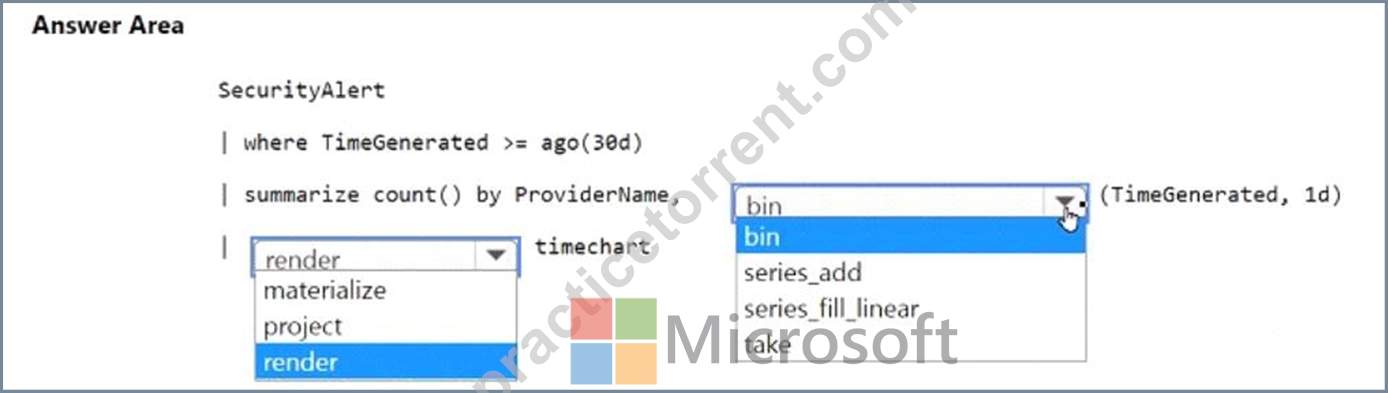
Answer:
Explanation: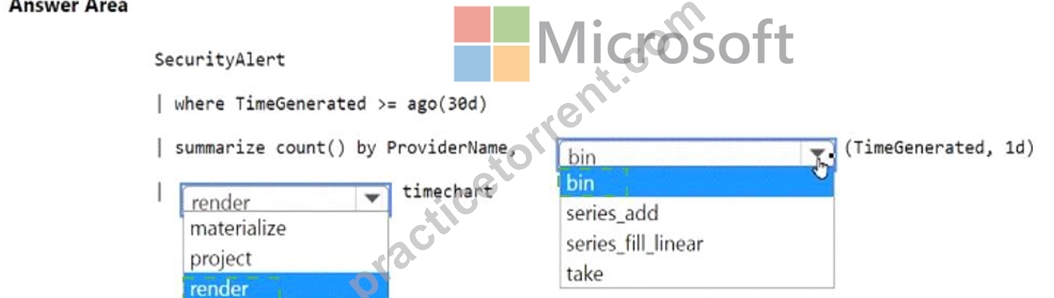
Explanation: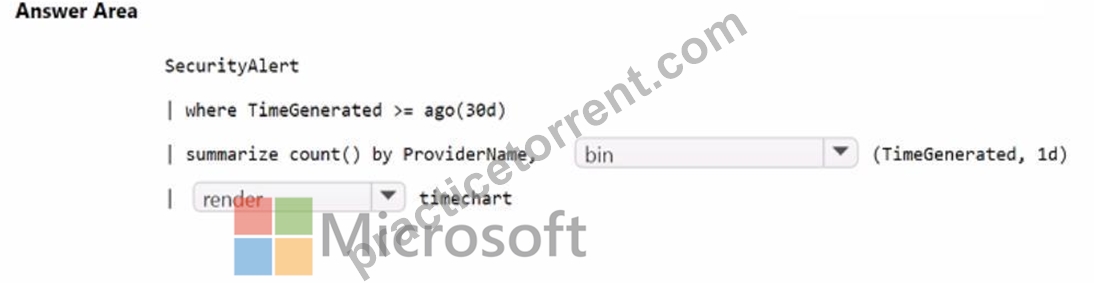
NEW QUESTION # 27
You have an Azure Sentinel deployment.
You need to query for all suspicious credential access activities.
Which three actions should you perform in sequence? To answer, move the appropriate actions from the list of actions to the answer area and arrange them in the correct order.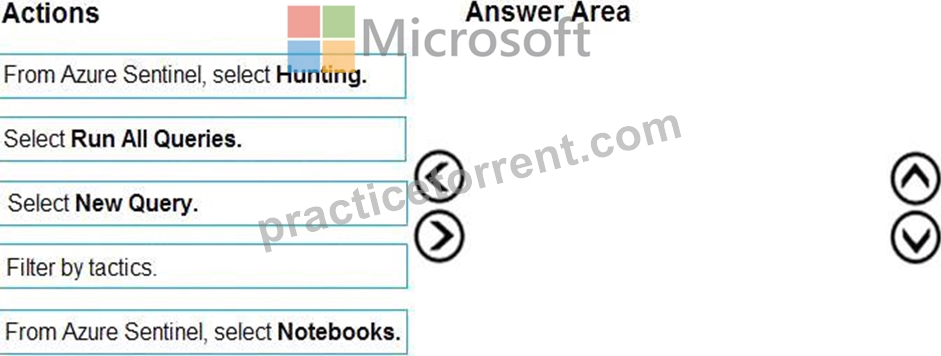
Answer:
Explanation: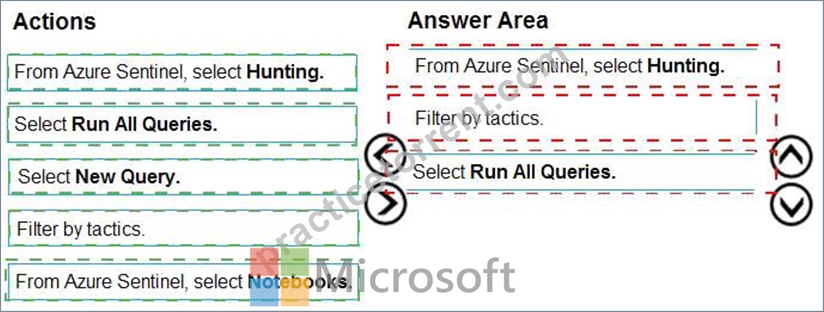
Explanation: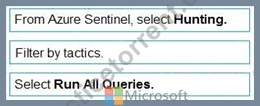
NEW QUESTION # 28
You have a Microsoft Sentinel workspace named Workspace1 and 200 custom Advanced Security Information Model (ASIM) parsers based on the DNS schema. You need to make the 200 parsers available in Workspace1.
The solution must minimize administrative effort. What should you do first?
- A. Copy the parsers to the Azure Monitor Logs page.
- B. Create a YAML file based on the DNS template.
- C. Create a JSON file based on the DNS template.
- D. Create an XML file based on the DNS template.
Answer: A
NEW QUESTION # 29
You have a Microsoft 365 E5 subscription that uses Microsoft Copilot for Security. You plan to run the following code to create a custom Copilot for Security plugin.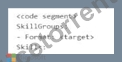
You need to specify a format and complete the code segment. Which format should you use for the <target> variable?
- A. SQL
- B. GPT
- C. KQL
- D. API
Answer: C
Explanation:
When authoring a custom plugin for Copilot for Security that queries security telemetry and returns structured results, the expected query/target format is Kusto Query Language (KQL). Copilot for Security integrates with Microsoft security data platforms (Microsoft Sentinel/Log Analytics and Defender tables) where investigative and hunting queries are expressed in KQL. Official plugin examples and guidance show the plugin invoking a KQL query against a workspace or a Defender table and returning the results in the plugin response payload. KQL is the language used to interrogate event, alert, and entity tables (for example, DeviceProcessEvents, SecurityAlert, MicrosoftGraphActivityLogs) and is the supported format when a plugin's purpose is to retrieve and return telemetry to Copilot for Security. Other formats listed (API, GPT, SQL) are not the standard query language for Defender/Sentinel data: APIs are endpoints for programmatic access, GPT is a model format, and SQL is not used for Azure Monitor / Sentinel tables. Therefore when the plugin's <target> must specify the query format against security telemetry, KQL is the correct choice.
NEW QUESTION # 30
You have a Microsoft 365 E5 subscription.
You plan to perform cross-domain investigations by using Microsoft 365 Defender.
You need to create an advanced hunting query to identify devices affected by a malicious email attachment.
How should you complete the query? To answer, select the appropriate options in the answer area.
NOTE: Each correct selection is worth one point.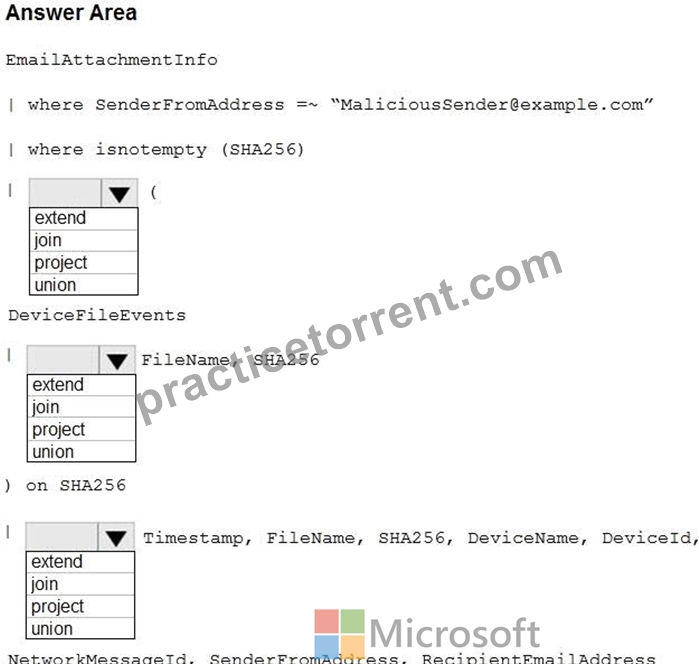
Answer:
Explanation: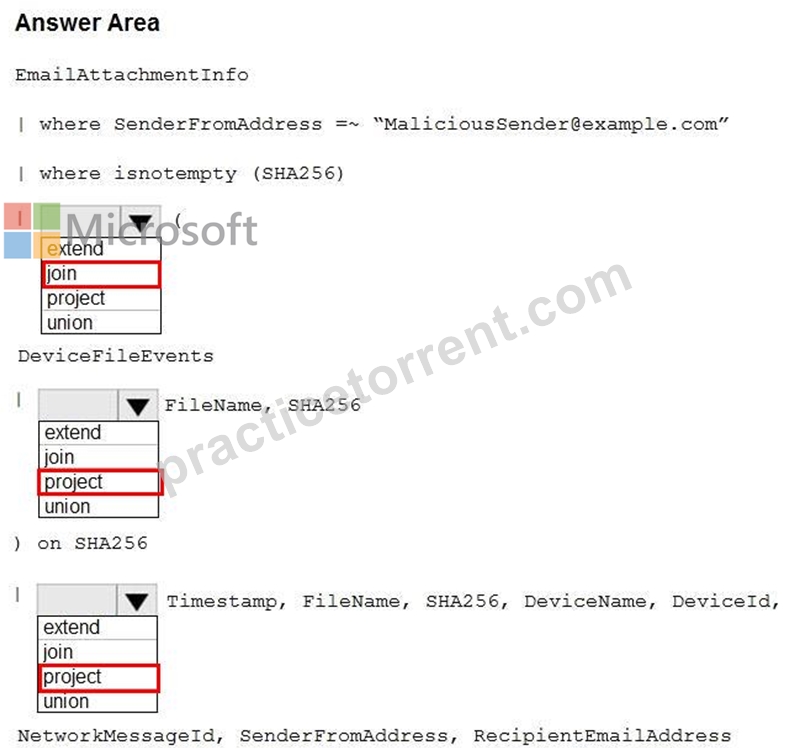
Reference:
https://docs.microsoft.com/en-us/microsoft-365/security/mtp/advanced-hunting-query-emails-devices?view=o365-worldwide
NEW QUESTION # 31
You have a Microsoft Sentinel workspace that has a default data retention period of 30 days. The workspace contains two custom tables as shown in the following table.
Each table ingested two records per day during the past 365 days.
You build KQL statements for use in analytic rules as shown in the following table.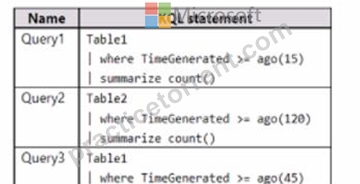
For each of the following statements, select Yes if the statement is true. Otherwise, select No.
NOTE: Each correct selection is worth one point.
Answer:
Explanation:
NEW QUESTION # 32
You have an Azure Sentinel deployment.
You need to query for all suspicious credential access activities.
Which three actions should you perform in sequence? To answer, move the appropriate actions from the list of actions to the answer area and arrange them in the correct order.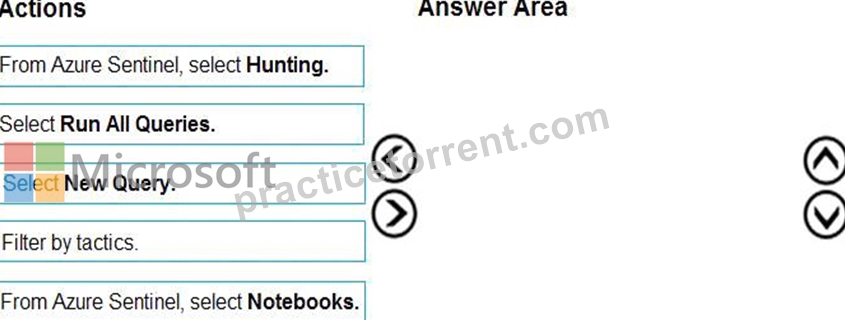
Answer:
Explanation: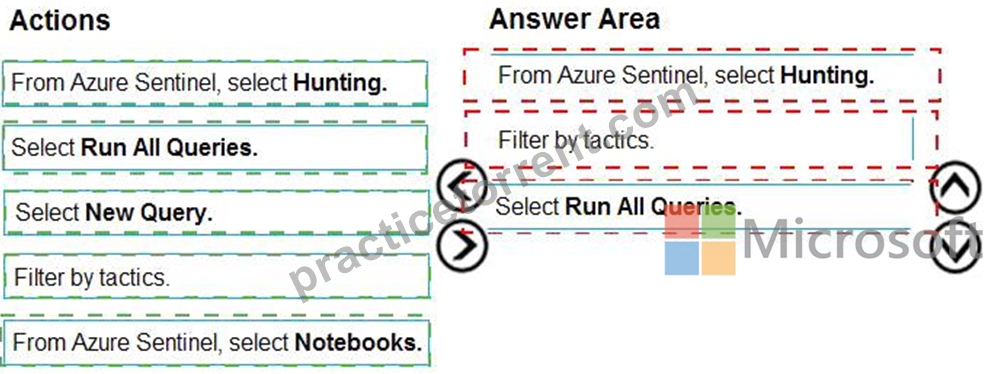
Explanation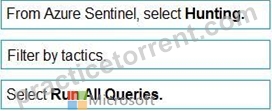
NEW QUESTION # 33
You have an Azure subscription named Sub1. Sub1 contains a Microsoft Sentinel workspace named SW1 and a virtual machine named VM1 that runs Windows Server. SW1 collects security logs from VM1 by using the Windows Security Events via AMA connector.
You need to limit the scope of events collected from VM1. The solution must ensure that only audit failure events are collected.
How should you complete the filter expression for the connector? To answer, select the appropriate options in the answer area.
NOTE: Each correct selection is worth one point.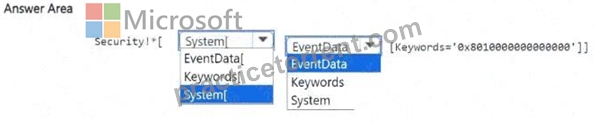
Answer:
Explanation: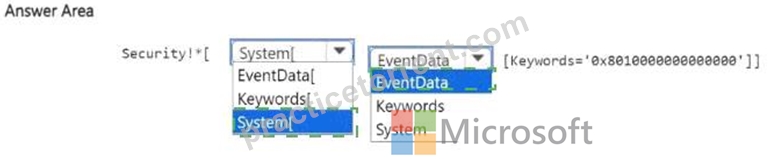
Explanation:
In Microsoft Sentinel, when using the Windows Security Events via AMA (Azure Monitor Agent) connector, you can configure an XPath filter expression to control which Windows security events are collected from a connected virtual machine.
Microsoft's documentation specifies that event filtering is based on the EventLog XML schema, and filtering by Keywords allows you to target specific audit categories. In Windows Security logs, events are categorized as follows by their Keywords bitmask:
* 0x8020000000000000 # Audit Success events
* 0x8010000000000000 # Audit Failure events
Since the requirement is to collect only audit failure events, the XPath filter must include only the System node (which contains the event header metadata) and filter by the Keywords attribute equal to
0x8010000000000000.
The correct XPath syntax for the filter in this case is:
Security!*[System[Keywords='0x8010000000000000']]
Explanation of components:
* Security!* - Targets the Windows Security event log.
* System[...] - Refers to the event's header metadata section (where Keywords, EventID, and Level are stored).
* Keywords='0x8010000000000000' - Matches only events that have the Audit Failure bit set.
Therefore, only events with Audit Failure outcomes will be collected from VM1, satisfying the requirement to minimize event ingestion and reduce unnecessary log noise.
# Final answer: Security!*[System[Keywords='0x8010000000000000']]
NEW QUESTION # 34
You have an Azure subscription.
You need to delegate permissions to meet the following requirements:
* Enable and disable Azure Defender.
* Apply security recommendations to resource.
The solution must use the principle of least privilege.
Which Azure Security Center role should you use for each requirement? To answer, drag the appropriate roles to the correct requirements. Each role may be used once, more than once, or not at all. You may need to drag the split bar between panes or scroll to view content.
NOTE: Each correct selection is worth one point.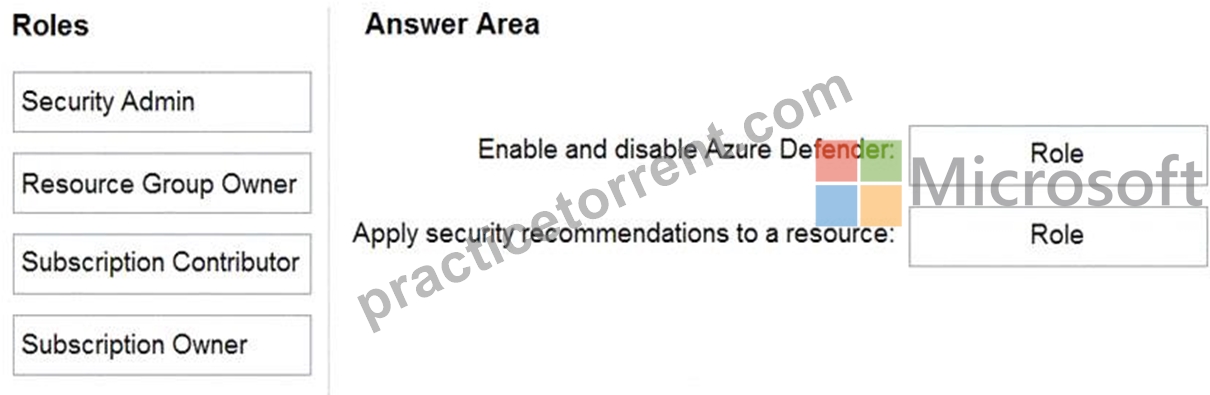
Answer:
Explanation: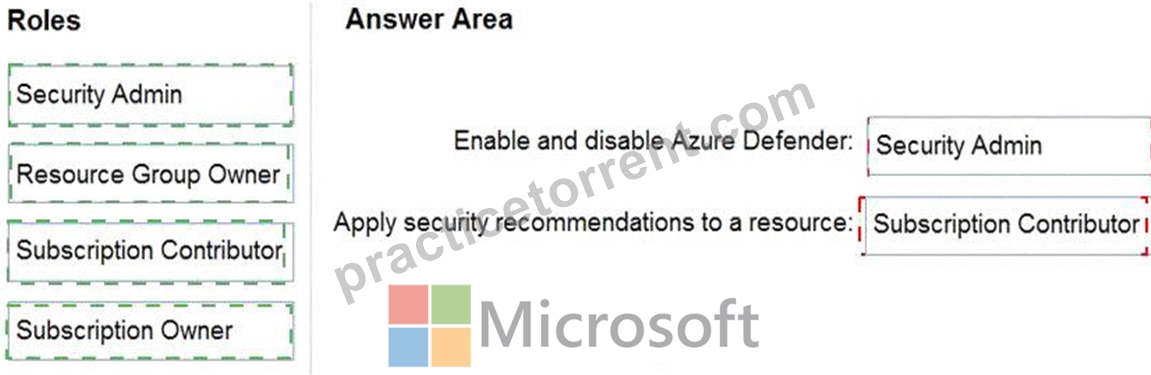
Explanation: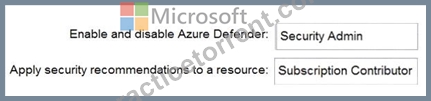
Reference:
https://docs.microsoft.com/en-us/azure/security-center/security-center-permissions
NEW QUESTION # 35
You need to create a query for a workbook. The query must meet the following requirements:
* List all incidents by incident number.
* Only include the most recent log for each incident.
How should you complete the query? To answer, select the appropriate options in the answer area.
NOTE: Each correct selection is worth one point.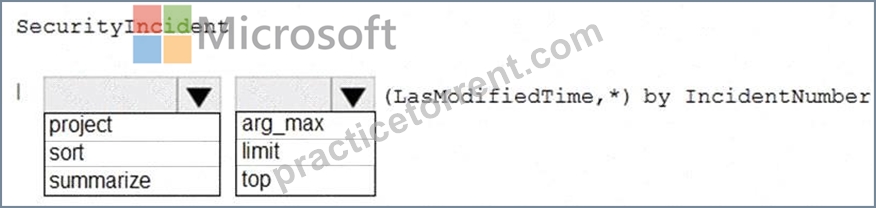
Answer:
Explanation: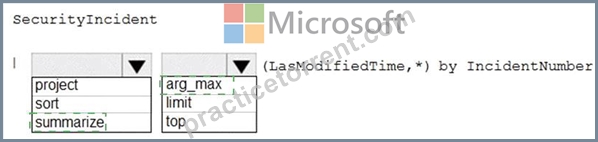
Explanation: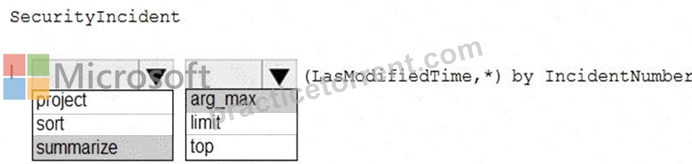
In Microsoft Sentinel (now part of Microsoft Defender XDR), Kusto Query Language (KQL) is used to create queries for workbooks, analytics rules, and hunting queries. The SecurityIncident table contains all incidents created in Sentinel, including their timestamps, severities, and metadata.
To meet the requirements:
* "List all incidents by incident number" # means grouping results by the field IncidentNumber.
* "Only include the most recent log for each incident" # means you must return only the latest record for each incident.
In KQL, the correct operator for this purpose is summarize arg_max(). The function arg_max (LastModifiedTime, *) returns the row (record) that has the maximum LastModifiedTime for each group- in this case, each unique IncidentNumber-along with all its other columns (indicated by *).
Therefore, the complete and correct query is:
SecurityIncident
| summarize arg_max(LastModifiedTime, *) by IncidentNumber
* summarize aggregates records based on the specified grouping key (IncidentNumber).
* arg_max() selects the latest record based on LastModifiedTime.
This query will return exactly one record per IncidentNumber, corresponding to the most recently modified incident entry-perfectly fulfilling the requirement of showing the latest incident state for each case in a Sentinel workbook.
# Correct selections:
* First dropdown: summarize
* Second dropdown: arg_max
NEW QUESTION # 36
You have an Azure subscription that contains a user named User1.
User1 is assigned an Azure Active Directory Premium Plan 2 license.
You need to identify whether the identity of User1 was compromised during the last 90 days.
What should you use?
- A. Identity Secure Score recommendations
- B. the risky sign-ins report
- C. the risky users report
- D. the risk detections report
Answer: D
Explanation:
The risk detections report contains filterable data for up to the past 90 days (three months).
https://learn.microsoft.com/en-us/azure/active-directory/identity-protection/howto-identity- protection-investigate-risk#risk-detections
NEW QUESTION # 37
You have a Microsoft Sentinel workspace.
You need to create playbooks that meet the following requirements:
* Use an automation rule to trigger actions on an entity.
* Call the Entities - Get Hosts action.
Which types of playbooks should you use, and which parameters should you specify? To answer, select the appropriate options in the answer area.
NOTE: Each correct selection is worth one point.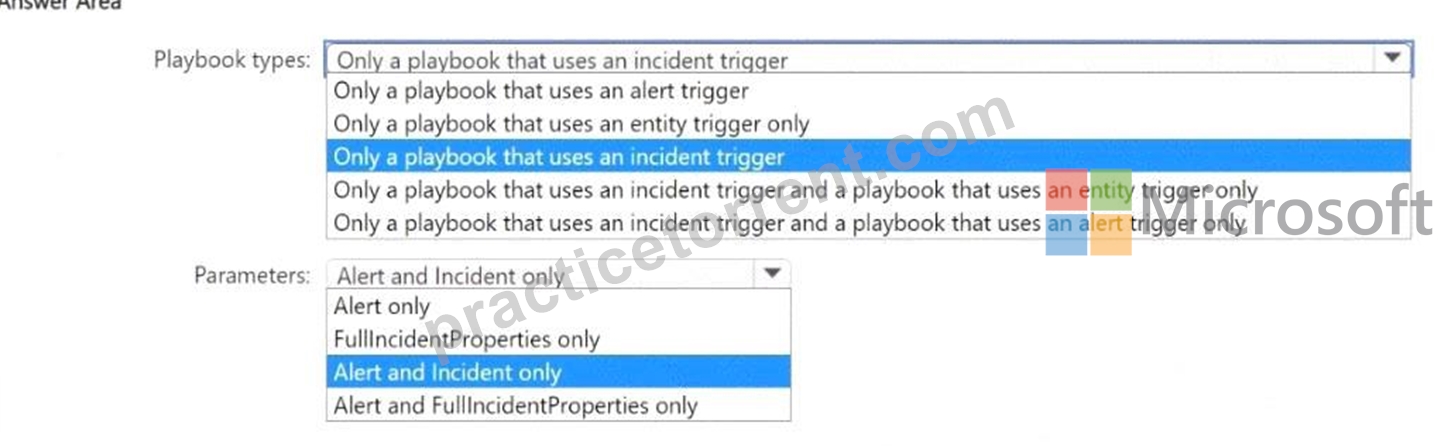
Answer:
Explanation: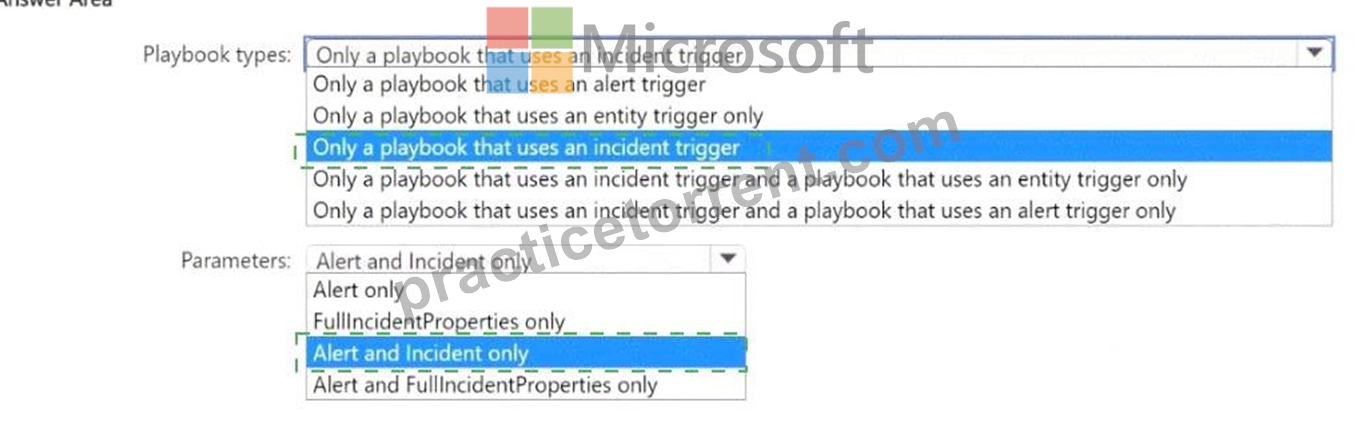
Explanation:
NEW QUESTION # 38
You have a Microsoft Sentinel workspace.
You have a query named Query1 as shown in the following exhibit.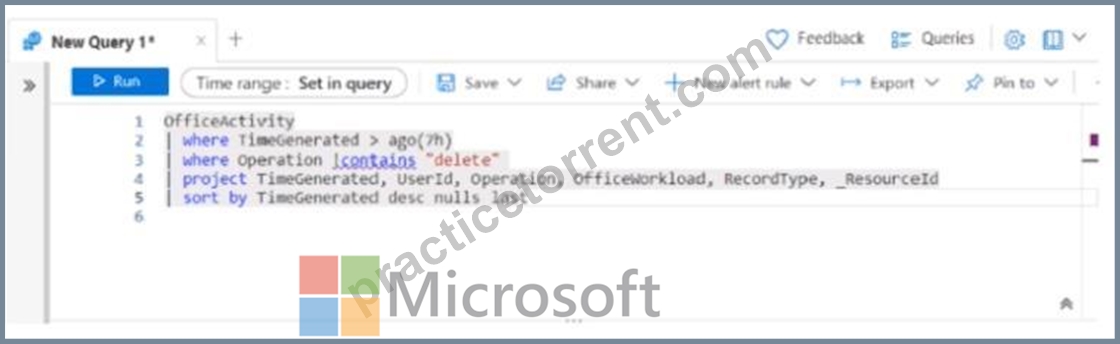
You plan to create a custom parser named Parser 1. You need to use Query1 in Parser1. What should you do first?
- A. Remove line 2.
- B. In line 3, replace the 'contains operator with the !has operator.
- C. Remove line 5.
- D. In line 4. remove the TimeGenerated predicate.
Answer: A
Explanation:
This can be confirmed by referring to the official Microsoft documentation on creating custom log queries in Azure Sentinel, which states that the "has" operator should not be used in the query, and that it is unnecessary.
Reference: https://docs.microsoft.com/en-us/azure/sentinel/query-custom-logs
NEW QUESTION # 39
You need to create the test rule to meet the Azure Sentinel requirements. What should you do when you create the rule?
- A. From Set rule logic, map the entities.
- B. From Set rule logic, turn off suppression.
- C. From Analytics rule details, configure the tactics.
- D. From Analytics rule details, configure the severity.
Answer: A
Explanation:
Reference:
https://docs.microsoft.com/en-us/azure/sentinel/tutorial-detect-threats-custom
NEW QUESTION # 40
You have a Microsoft Sentinel workspace named Workspacel that contains a table named CommonSecurityLog. You ingest logs into CommonSecurityLog. CommonSecurityLog has an average log ingestion time of five minutes.
You need to create an analytics rule that has a lookback period of seven minutes and uses the data in the CommonSecurityLog table. The solution must meet the following requirements:
* Prevent the same event from being processed twice.
* Minimize the number of missed events due to log ingestion delays.
How should you complete the KQL query that defines the rule? To answer, select the appropriate options in the answer area.
NOTE: Each correct selection is worth one point.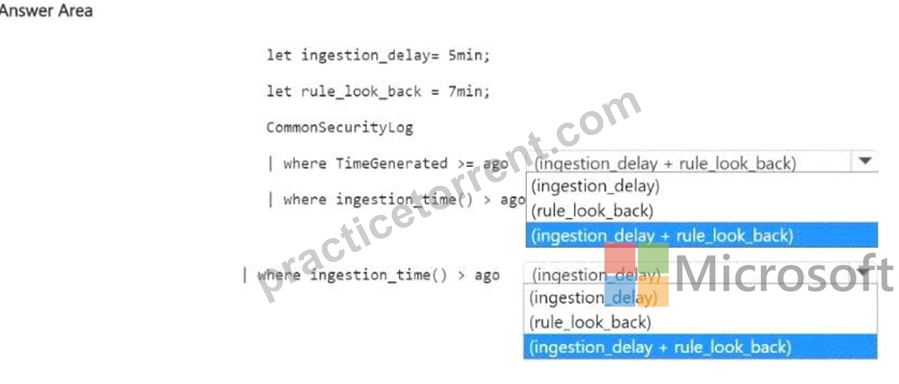
Answer:
Explanation: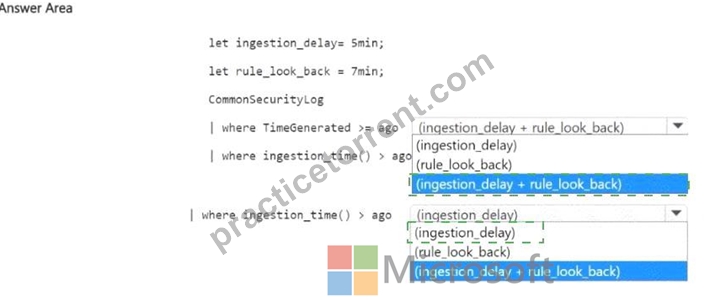
Explanation: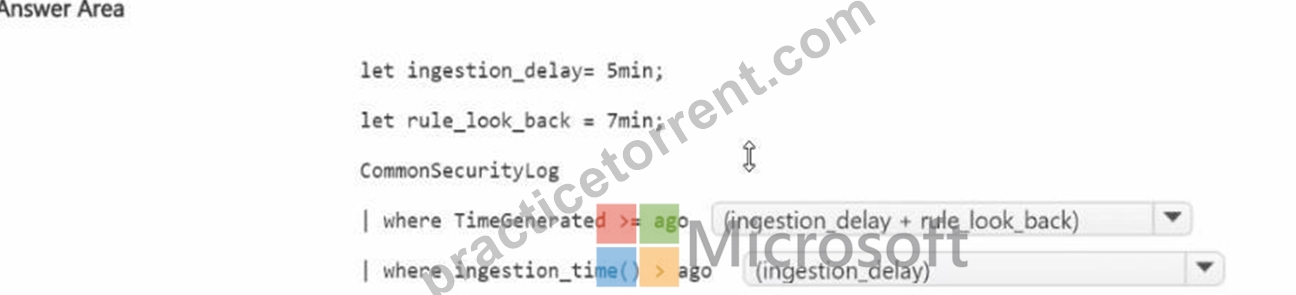
When creating scheduled analytics rules in Microsoft Sentinel, you should account for ingestion delay so late-arriving events aren't missed, while also avoiding reprocessing the same events. The recommended pattern is to widen the TimeGenerated w indow by the expected delay and then gate results by ingestion_time() to include only data that actually arrived within the delay window:
let ingestion_delay = 5min;
let rule_look_back = 7min;
CommonSecurityLog
| where TimeGenerated > = ago(ingestion_delay + rule_look_back) // cover late arrivals
| where ingestion_time() > ago(ingestion_delay) // only newly ingested data
* TimeGenerated > = ago(ingestion_delay + rule_look_back) ensures the query looks back 7 + 5 = 12 minutes , so events that were generated up to 7 minutes ago but arrived up to 5 minutes late are still captured.
* ingestion_time() > ago(ingestion_delay) limits results to items ingested in the last 5 minutes , preventing the same already-processed events from being picked up again on the next run, while minimizing misses due to late ingestion.
Thus, choose (ingestion_delay + rule_look_back) for the first blank and (ingestion_delay) for the second.
NEW QUESTION # 41
......
SC-200 Dumps Updated Practice Test and 390 unique questions: https://actual4test.practicetorrent.com/SC-200-practice-exam-torrent.html